

Token Utility
This page provides a detailed breakdown of each $APPEX utility and how it functions within the protocol. Each utility creates a distinct demand vector tied to real economic activity.
1. Payment Backing
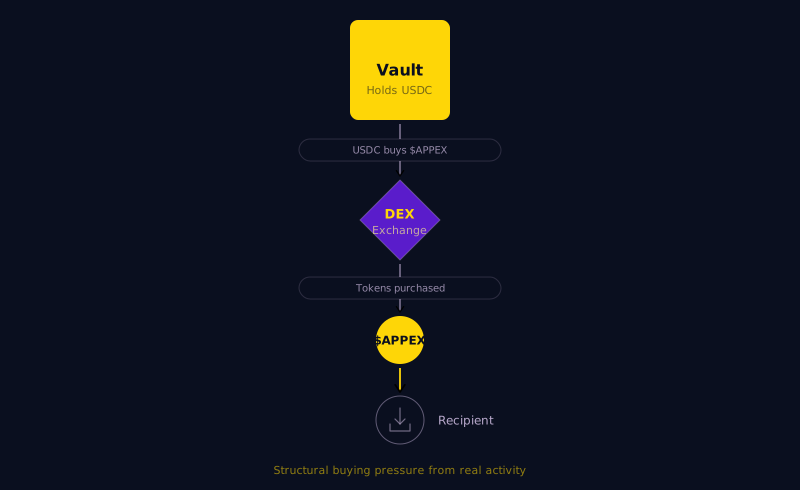
When a borrower's downstream recipient selects $APPEX as their payout format, the vault executes a market purchase:
- USDC is drawn from the vault to fund the payout
- USDC routes to a decentralized exchange (DEX)
- $APPEX tokens are purchased at market price
- Tokens transfer to the recipient's wallet
This creates structural DEX demand at every settlement. The buying pressure is not speculative. It originates from real economic transactions where businesses are funding payouts to their users. Token acquisition happens entirely onchain through the DEX, not through any centralized mechanism.
Selling Pressure Neutrality
If a recipient later sells their $APPEX, they sell into liquidity that was already injected by the original purchase. The net effect on token supply is neutral. The system creates sustainable buying pressure because every token distributed was first bought on the open market. New demand is continually generated as new payouts occur.
Payout Flexibility
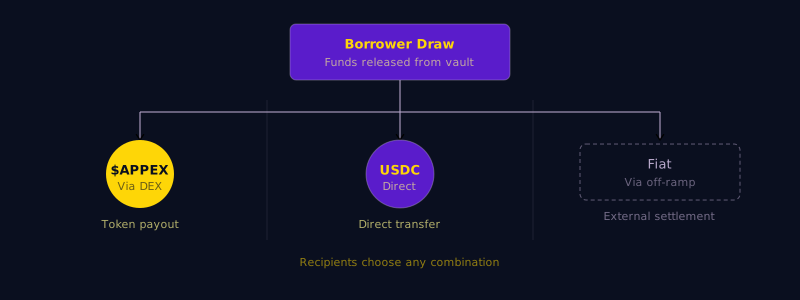
Recipients are not forced into $APPEX. They choose their payout proportions across three formats:
- $APPEX - USDC from the vault routes to DEX for token purchase. Use within partner platforms for discounted services or hold for potential appreciation.
- USDC - Stablecoins transfer directly from the vault. Immediate liquidity for operational needs. No token exposure or selling pressure on $APPEX.
- Fiat - USDC routes through integrated off-ramp partners for bank deposit. 1-3 business days to arrive.
- Any combination - e.g., 40% $APPEX, 30% USDC, 30% fiat. Adjust preferences at any time.
No fees are charged to recipients. The payout process is designed to be frictionless: recipients do not need exchange accounts, wallet setup, or crypto knowledge to receive $APPEX. They select a percentage and tokens arrive.
2. Staking Rewards
LPs who stake $APPEX receive distributions from protocol fees. This is a second yield stream on top of the base yield earned from vault NAV appreciation.
Reward source: 50% of all protocol fees are converted to $APPEX and distributed to stakers. When borrowers pay protocol fees in $APPEX (at 25% discount), the tokens transfer directly to stakers without a DEX purchase.
Staking is capacity-limited. The amount of $APPEX eligible for rewards is hard-capped by the number of LP tokens locked. This ensures only real liquidity providers earn staking rewards.
For the complete staking mechanism, see Staking.
3. Fee Discounts
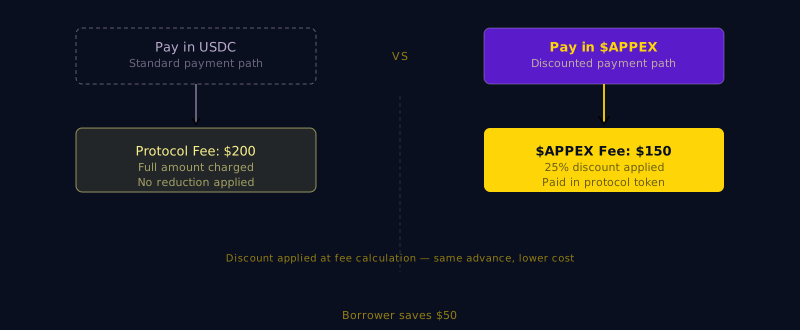
Borrowers can pay their protocol fee in $APPEX at a 25% discount. This is one of the strongest demand drivers for $APPEX because it directly improves borrower margins.
| Protocol Fee Payment | Rate | On a 2% Protocol Fee ($10K advance) |
|---|---|---|
| Paid in USDC | 100% of negotiated rate | $200 |
| Paid in $APPEX | 75% of negotiated rate | $150 in $APPEX (saves $50) |
This creates a strong economic incentive for borrowers to accumulate $APPEX through two channels:
- Direct acquisition. Borrowers purchase $APPEX on the open market to pay fees at a discount.
- Organic accumulation. When recipients spend $APPEX on the borrower's platform (subscriptions, services, marketplace purchases), the borrower accumulates tokens passively. These accumulated tokens can then be used to pay protocol fees at the discounted rate, improving margins without any additional market purchase.
The discount applies only to the protocol fee, not the LP yield fee. LP economics are preserved regardless of how the borrower pays.
When borrowers pay fees in $APPEX, those tokens transfer directly to the staking contract for distribution to LPs. No DEX purchase is needed. This creates a sustainable drain for tokens within the protocol. Partners receiving $APPEX from their users do not need to sell tokens to fund operations. Instead, they cycle tokens back through the system to pay fees at better rates.
4. Platform Utility
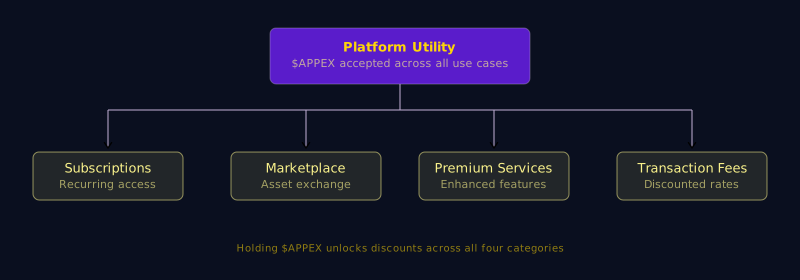
$APPEX functions as a payment method within partner platforms operated by approved borrowers:
| Use Case | Description |
|---|---|
| Subscriptions | Pay for SaaS subscriptions and add-ons at discounted rates |
| Marketplace | Purchase third-party tools and services on partner marketplaces |
| Premium services | Access data intelligence, compliance scans, security tools |
| Transaction fees | Pay marketplace transaction fees in $APPEX |
This creates a circular economy: recipients receive $APPEX through payouts, spend $APPEX on partner platforms, and borrowers accumulate $APPEX for fee discounts.
5. Governance
Staked $APPEX confers governance rights. Each staked token carries one vote.
Governance decisions include:
- Vault parameter adjustments (advance limits, redemption caps)
- New borrower approvals and borrowing limits
- Fee structure modifications
- New vault creation for different risk profiles
- DeFi protocol selection for capital deployment
For the complete governance framework, see Governance.
The $APPEX Cycle
All five utilities create a self-reinforcing loop where each participant has an economic reason to hold or use $APPEX:
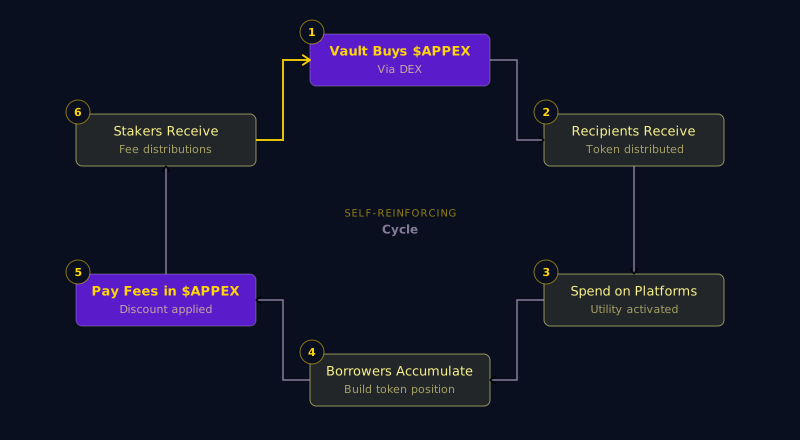
- Recipients receive $APPEX through payouts. USDC from the vault purchases tokens on a DEX. This is buying pressure from real business activity.
- Recipients spend $APPEX on partner platform services at discounted rates. Tokens flow from recipients to borrowers.
- Borrowers accumulate $APPEX through platform utility payments. No market selling required. Tokens stay within the protocol.
- Borrowers pay protocol fees in $APPEX at 25% discount. This improves their margins and cycles tokens into staker distributions.
- Stakers receive $APPEX from protocol fee distributions. LPs who have committed both USDC and $APPEX receive token rewards.
- New payouts generate fresh buying pressure as the vault processes new advances. The cycle continues.
This circular flow benefits every participant. Recipients get frictionless token access. Borrowers get discounted fees. LPs get token distributions. The token flows through the protocol with utility at every step.
Info: The $APPEX cycle is powered by real economic activity: borrower fees from actual capital deployment. It does not depend on new token issuance, liquidity mining incentives, or speculative trading volume. These fee distributions are not emissions; $APPEX emissions are a separate, finite programme funded from the Incentives allocation. When fees are paid in USDC, tokens are bought with real liquidity. When fees are paid in $APPEX, tokens cycle through the protocol rather than being sold.