

Risk Framework
This page provides an honest assessment of every material risk facing appeX Protocol participants. Each risk is described with its severity, who is affected, how it could materialize, what mitigations are in place, and what residual risk remains even after mitigations.
appeX believes that transparent risk disclosure builds trust. Hiding risks does not eliminate them. It transfers them to uninformed participants. Every participant should read this page before committing capital.
| # | Risk | Severity | Primary Impact |
|---|---|---|---|
| 1 | Borrower Default | High | LP capital loss via NAV impairment |
| 2 | Vault Utilization | Medium | Delayed LP withdrawals |
| 3 | Smart Contract | High | Potential loss of deposited funds |
| 4 | Centralization | Preliminary | Dependence on appeX team decisions |
| 5 | Market / $APPEX | Medium | Token price volatility, staker returns |
| 6 | Oracle / Data Feed | Preliminary | NAV mispricing, incorrect fee calculations |
| 7 | Regulatory | Medium | Operational restrictions, access limitations |
| 8 | DeFi Composability | Preliminary | Risk from Aave/Compound dependencies |
| 9 | Concentration | Medium | Outsized impact from single borrower |
1. Borrower Default Risk
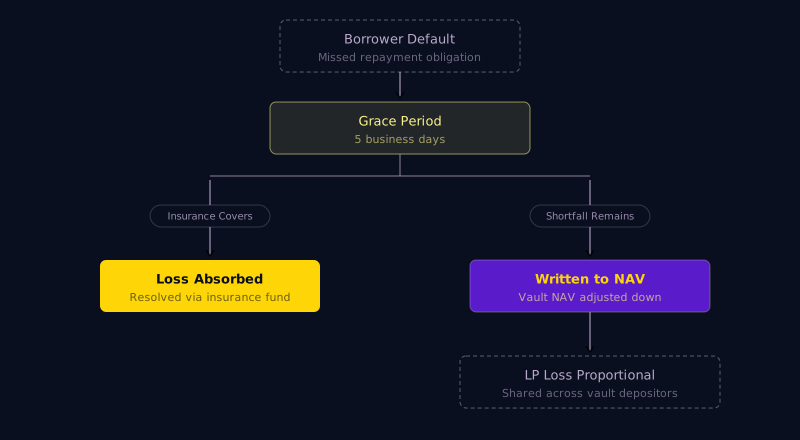
What it is: An approved borrower fails to repay principal and fees to the vault. This is the primary risk to LP capital.
Severity: High
Who is affected: Liquidity Providers (vault NAV decreases, LP token value drops)
How it could happen:
- Borrower's customers fail to pay on their receivables
- Borrower experiences financial distress unrelated to receivable performance
- Fraud or misrepresentation during borrower onboarding
Mitigation:
- Rigorous borrower onboarding with credit evaluation, financial review, and background checks
- Borrowers are legally obligated to repay regardless of downstream outcomes. The vault's counterparty is the company, not individual receivables.
- Concentration guidelines limit exposure to any single borrower
- Grace period (5 days) before impairment, allowing time for delayed but eventual payment
- Insurance coverage where available to absorb losses
- Loss of vault access as a deterrent. Borrowers who default lose the ability to use appeX infrastructure permanently.
Residual risk: Default risk cannot be eliminated entirely. Even with rigorous underwriting, some borrowers may fail. Losses from defaults are socialized across LP shares proportionally.
2. Vault Utilization Risk
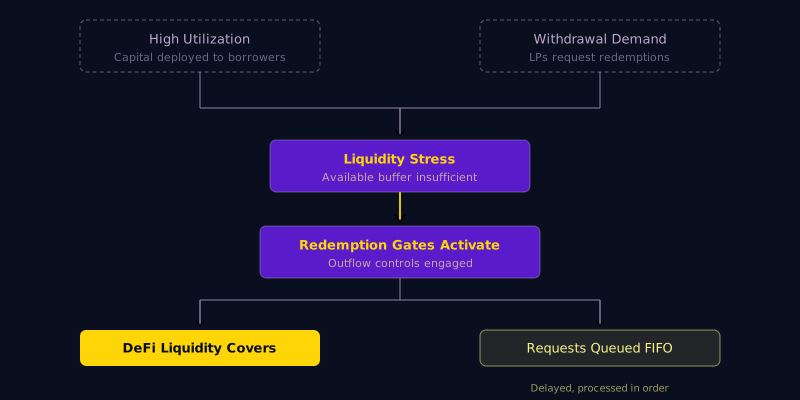
What it is: Mismatches between capital deployment and LP withdrawal demand create liquidity stress.
Severity: Medium
Who is affected: Liquidity Providers (delayed withdrawals)
How it could happen:
- High utilization period coincides with concentrated withdrawal requests
- Borrower repayments arrive later than expected, reducing available liquidity
- Market conditions trigger simultaneous exits by multiple LPs
Mitigation:
- All unborrowed capital is deployed to DeFi protocols (Aave, Compound) and can be withdrawn instantly for redemptions
- The team maintains offchain liquidity reserves as an additional backstop for redemption demand during periods of stress
- Daily redemption caps prevent a rush of withdrawals
- Per-request limits prevent single large LPs from consuming all available liquidity
- FIFO queue ensures fair processing of excess withdrawal requests
Residual risk: During extreme stress, LP withdrawals may be delayed for multiple days. Receivables are not liquidated to service redemptions. LPs should consider their liquidity needs before depositing.
3. Smart Contract Risk
What it is: Vulnerabilities in the vault, staking, or token contracts could lead to loss of funds.
Severity: High
Who is affected: All participants
How it could happen:
- Undiscovered bugs in smart contract logic
- Exploits targeting NAV calculation, LP token minting, or redemption mechanics
- Reentrancy attacks, oracle manipulation, or access control failures
Mitigation:
- Third-party security audits before mainnet deployment (see Audits)
- Bug bounty program for ongoing vulnerability discovery (see Bug Bounty)
- Planned multi-sig administration for critical protocol parameters
- Gradual deployment with conservative initial parameters
Residual risk: No audit can guarantee the absence of all vulnerabilities. Smart contract risk is inherent to onchain systems. Users should never deposit more than they can afford to lose.
4. Centralization Risk
What it is: Key protocol decisions are made by the appeX team rather than through decentralized governance.
Severity: Preliminary assessment -- not yet formally rated.
Who is affected: All participants
Where centralization exists:
- Borrower onboarding. The appeX team decides who can borrow from the vault.
- Credit assessment. Borrower creditworthiness is evaluated offchain by the team.
- Protocol administration. Multi-sig holders can adjust certain protocol parameters.
- Offchain operations. Collections management, fiat off-ramps, and compliance are centrally operated.
Mitigation:
- Governance will progressively transfer decision-making authority to $APPEX stakers
- Borrower approval criteria will be documented and standardized
- Multi-sig operations follow published procedures
- Offchain decisions are auditable through onchain transaction records
Residual risk: Early-stage protocols require some centralization for operational efficiency. The path to decentralization is progressive, not immediate. Users should understand that the team has significant control during the initial phase.
5. Market and Liquidity Risk ($APPEX)
What it is: The $APPEX token may experience price volatility, low liquidity, or sustained selling pressure.
Severity: Medium
Who is affected: $APPEX holders and stakers
How it could happen:
- Low trading volume on DEX pairs creates high slippage
- Large unlock events (vesting schedule) create temporary selling pressure
- Market-wide crypto downturns reduce demand for all tokens
- Protocol fee distributions (which buy $APPEX on DEX) are insufficient to offset natural selling
Mitigation:
- Liquidity allocation (10% of supply) dedicated to DEX liquidity pools at TGE
- Vesting schedules with 6 to 12 month cliffs prevent immediate insider selling
- Structural buying pressure from protocol fee distributions and payout purchases
- Staking lock periods (3-6 months) reduce circulating supply
Residual risk: Token price is ultimately determined by market forces. Structural demand mechanisms reduce but do not eliminate volatility. $APPEX should be evaluated as a utility token with governance rights, not a guaranteed store of value.
6. Oracle and Data Feed Risk
What it is: The protocol relies on offchain data (receivable verification, delivery confirmation) to authorize vault draws. Inaccurate data could lead to improper capital deployment.
Severity: Preliminary assessment -- not yet formally rated.
Who is affected: Liquidity Providers
How it could happen:
- Borrower submits fraudulent receivable data to draw capital without legitimate backing
- Data feed failures delay or prevent accurate NAV updates
- Verification systems fail to catch discrepancies between reported and actual delivery
Mitigation:
- Borrowers are responsible for verification. They bear the repayment obligation regardless of data accuracy.
- Variance guardrails flag discrepancies exceeding 5-10% for manual review
- NAV is refreshed before every deposit and redemption to prevent stale pricing
- Multiple data sources cross-referenced during verification
Residual risk: Offchain data cannot be verified onchain with the same certainty as onchain transactions. The borrower's repayment obligation is the primary safeguard. Even if underlying data is imperfect, the borrower must repay.
7. Regulatory Risk
What it is: Changes in regulatory frameworks could affect protocol operations, token classification, or user access.
Severity: Medium
Who is affected: All participants
How it could happen:
- Stablecoin regulations restrict USDC usage or DeFi lending
- Securities classification applied to LP tokens or $APPEX
- Geographic restrictions expand, limiting user access
- KYC/AML requirements imposed on permissionless deposit mechanisms
Mitigation:
- Geographic restrictions enforced at the frontend layer via geofencing for prohibited regions
- Legal structure designed with regulatory considerations in mind
- Ongoing monitoring of regulatory developments across jurisdictions
Residual risk: Regulatory environments are evolving and unpredictable. No mitigation can guarantee future compliance with regulations that do not yet exist.
8. DeFi Composability Risk
What it is: All unborrowed vault capital is deployed to third-party DeFi protocols (Aave, Compound), which carries the risk of those protocols.
Severity: Preliminary assessment -- not yet formally rated.
Who is affected: Liquidity Providers
How it could happen:
- Smart contract exploit in Aave or Compound
- Liquidity crisis in the underlying lending market
- Oracle failure in the DeFi protocol affecting deposited funds
Mitigation:
- Capital deployed only to established, audited protocols with multi-year track records
- Deployment amounts managed relative to total vault NAV
- Governance can modify or remove approved DeFi protocols
- Rapid recall mechanisms to pull capital back to the vault when needed
Residual risk: Any interaction with external smart contracts introduces dependency risk. The protocols selected (Aave, Compound) are among the most battle-tested in DeFi, but risk cannot be zero.
9. Concentration Risk
What it is: Excessive exposure to a single borrower, industry, or geographic region amplifies the impact of a single default event.
Severity: Medium
Who is affected: Liquidity Providers
How it could happen:
- One borrower represents a disproportionate share of vault advances
- All borrowers operate in the same industry, creating correlated default risk
- A single large default materially impacts vault NAV
Mitigation:
- Per-borrower concentration guidelines (recommended 20-25% max per customer, 10-15% per supplier)
- Borrower diversification across industries as the protocol scales
- Future vault separation isolates different risk categories
- Governance oversight of borrower approvals and limits
Residual risk: At launch, vault concentration may be higher than target due to a limited initial borrower pool. As more borrowers are onboarded, concentration decreases naturally.
Risk Summary Matrix
| Risk | Severity | Primary Mitigation | Residual Exposure |
|---|---|---|---|
| Borrower Default | High | Rigorous onboarding, insurance, repayment obligation | Cannot be eliminated |
| Vault Utilization | Medium | Redemption gates, DeFi liquidity access | Delays possible under stress |
| Smart Contract | High | Audits, bug bounty, gradual deployment | Inherent to onchain systems |
| Centralization | Preliminary | Progressive decentralization via governance | Significant in early phase |
| Market / $APPEX Liquidity | Medium | Structural demand, vesting cliffs, staking locks | Market-driven |
| Oracle / Data Feed | Preliminary | Borrower repayment obligation, variance guardrails | Offchain data uncertainty |
| Regulatory | Medium | Compliance measures, geographic restrictions | Unpredictable |
| DeFi Composability | Preliminary | Established protocols only, governance control | External dependency |
| Concentration | Medium | Guidelines, diversification, vault separation | Higher at launch |
Warning: This risk framework is not exhaustive. New risks may emerge as the protocol evolves, market conditions change, or regulatory environments shift. Users should conduct their own risk assessment and never deposit more than they can afford to lose.