

Redemptions
This page explains how LPs withdraw capital from the vault by redeeming LP tokens for USDC. The gated redemption system protects vault liquidity while providing predictable exit paths for all participants.
How Redemptions Work
LPs submit a withdrawal request specifying either a number of shares to redeem or a dollar amount (converted to shares at the current price). Requests are accepted continuously but processed through a gated system that protects vault liquidity and ensures fair treatment of all LPs.
Redemption Calculation
Payout = Shares Redeemed × Current Share Price
Example: LP redeems 1,000 shares at a share price of $1.10. Expected payout: $1,100.
Processing Gates
Redemptions pass through up to three gates before settling. Each gate exists to protect the vault and remaining LPs from liquidity stress.
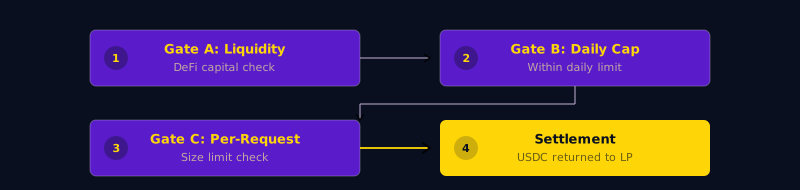
Gate A: Available Liquidity Check
Redemptions are funded by withdrawing capital from DeFi positions (Aave, Compound), which are highly liquid and can be accessed instantly.
| Condition | Result |
|---|---|
| DeFi-deployed capital >= redemption amount | Facilitated instantly |
| DeFi-deployed capital < redemption amount | Full request is queued. User is notified of available amount and can lower their request to match, or keep the full amount queued. |
Info: The vault does not liquidate outstanding borrower advances to service redemptions. Advances mature on their contractual timeline. Redemptions are served from DeFi-deployed capital, which can be withdrawn instantly.
Gate B: Daily Redemption Cap
A policy cap limits total daily exits. This is set as either a fixed number of shares or a percentage of LP token circulating supply (e.g., 5%).
- If the daily cap has already been reached, new requests are rejected (not queued) until the next processing window
- This is a hard limit. Even if DeFi liquidity is available, no further redemptions process once the cap is hit
- The cap is a global parameter affecting all LPs equally
Gate C: Per-Request Limit (Optional)
An optional per-request maximum (e.g., $100,000 per LP per day) prevents a single large LP from consuming all available liquidity.
- Amounts exceeding the limit are not partially filled. The user is notified of the maximum available and can adjust their request accordingly.
- Smaller LPs are not crowded out by large withdrawal requests
Settlement Mechanics
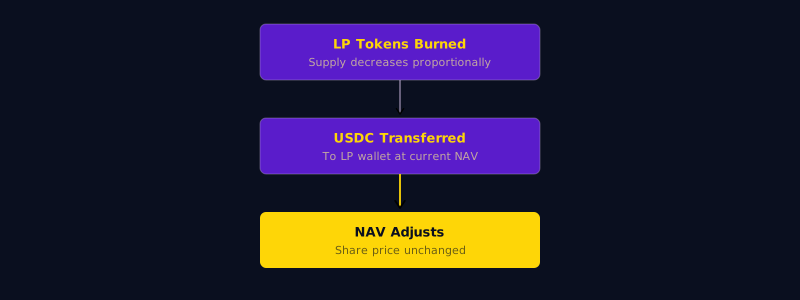
When a redemption settles:
- LP tokens are burned, reducing outstanding share supply
- USDC transfers from vault to LP wallet
- Share price remains unchanged. NAV decreases proportionally with shares burned.
Worked Example
Before redemption:
- Vault NAV: $110,000
- Shares outstanding: 100,000
- Share price: $1.10
LP redeems 10,000 shares:
- Payout: 10,000 × $1.10 = $11,000
- LP tokens burned: 10,000
After redemption:
- Vault NAV: $99,000
- Shares outstanding: 90,000
- Share price: $1.10 (unchanged)
Queued Redemptions
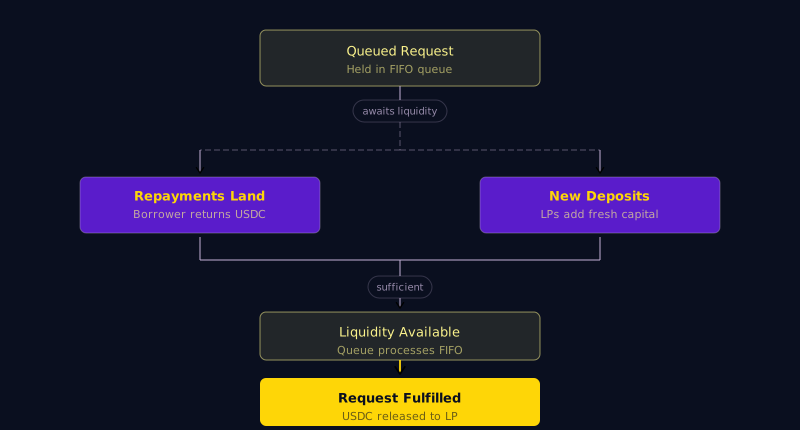
When a redemption request exceeds available DeFi-deployed liquidity, the full request is queued and processed in order:
- Requests enter the queue at the time of submission
- Queue is processed FIFO (first-in, first-out) each processing window
- As borrower repayments land or new deposits arrive, liquidity becomes available
- Queued requests are fulfilled in order until liquidity is exhausted or the queue is clear
Requests rejected due to the daily redemption cap are not queued. They must be resubmitted in a subsequent processing window.
LPs with queued requests retain their LP tokens (and continue accruing yield) until the redemption actually settles. This means waiting LPs are not penalized. Their position continues earning as long as their tokens exist.
The vault does not liquidate outstanding borrower advances to service redemptions. Advances mature on their contractual timeline. In no case are advances recalled early to facilitate withdrawals.
Staking Impact
Redemptions directly affect an LP's staking position. When LP tokens are burned, the LP's staking cap decreases proportionally.
An LP who redeems half their LP tokens can only stake half as many $APPEX at the eligible rate. Their share of $APPEX distributions shrinks accordingly. This creates a natural friction against withdrawal for LPs earning staking rewards. LPs watching their NAV grow and earning staking distributions have a clear incentive to maintain their position.
Redemption Fee (Optional)
An optional fee of 0 to 0.5% may be applied to protect remaining LPs from frequent withdrawals. The fee is deducted from the payout and retained by the vault.
Example: 0.25% fee on $11,000 redemption = $27.50 retained by vault.
| Without fee | With 0.25% fee |
|---|---|
| LP receives $11,000 | LP receives $10,972.50 |
| NAV drops by $11,000 | NAV drops by $10,972.50 |
The retained fee slightly benefits remaining LPs by preserving marginally more NAV per share. This discourages high-frequency deposits and withdrawals that could be used to extract short-term timing advantages.
Warning: Redemption timing depends on vault liquidity. During periods of high utilization or concentrated withdrawal requests, processing may take multiple days. This is a structural feature designed to protect vault solvency. LPs should consider their own liquidity needs before depositing and understand that immediate withdrawal is not always possible.