

How appeX Works
This page walks through the appeX Protocol at a high level: how capital flows, who participates, and how each party benefits.
Three Steps. One Liquidity Loop.
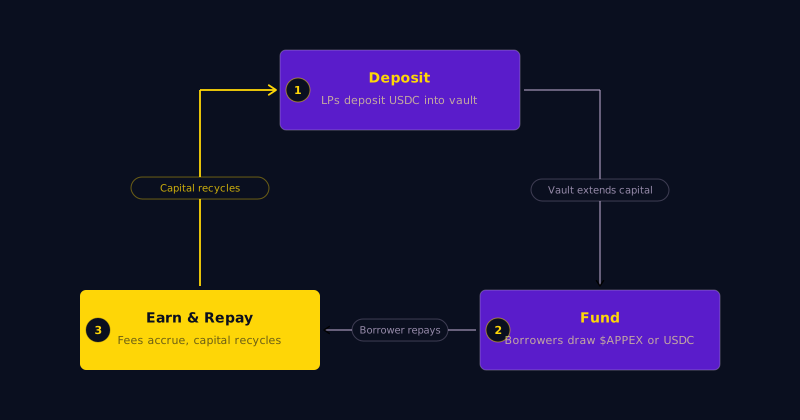
Step 1: Deposit
Liquidity Providers (LPs) deposit USDC into vault contracts onchain. Access is permissionless. No KYC is required. Geographic restrictions are enforced at the frontend layer for prohibited regions.
LPs receive vault-specific LP tokens representing proportional ownership of the vault's Net Asset Value (NAV). As borrower fees accrue, NAV increases and LP token value appreciates. This means yield is passive: LPs earn simply by holding their LP tokens as the vault generates fees.
The minimum deposit is 1 USDC. There is no hard cap on deposits.
Step 2: Fund
Approved borrowers draw capital from the vault and choose their format:
- $APPEX: USDC routes from the vault to a DEX, purchases $APPEX, and delivers tokens to the borrower. This creates structural buying pressure from real business activity.
- USDC: Stablecoins transfer directly from the vault to the borrower.
Each borrower operates under individually negotiated terms that define their fee rate based on payment term duration, volume, and creditworthiness. For example, a borrower with Net-90 terms might pay 9% on each advance, while a borrower with Net-30 terms might pay 5%.
The borrower decides how to deploy the capital downstream: instant payouts to their users, supplier payments, or other working capital needs. Recipients can receive funds in $APPEX, USDC, fiat (via off-ramp partners), or any combination. The vault's relationship is with the borrowing company. The borrower is responsible for repaying principal plus fees regardless of downstream outcomes.
Step 3: Earn and Repay
When the borrower's customer pays on their original terms (Net-30 to Net-180), the borrower repays the vault. The repayment covers two components:
- Principal plus LP yield fee. This accrues to vault NAV and benefits all LPs through share price appreciation.
- Protocol fee. This splits 50/50 between the appeX Treasury and $APPEX stakers. Borrowers can pay the protocol fee in $APPEX at a 25% discount.
The cycle then repeats as capital recycles into new advances.
Info: At 90-day average payment terms, capital turns approximately 4 times per year. A 5% LP yield fee per advance translates to roughly 20% simple annualized yield. Actual results vary based on utilization, term mix, and market conditions.
Two-Layer Architecture
appeX separates permissionless capital supply from permissioned credit extension. This is a deliberate design choice that lets each layer do what it does best.
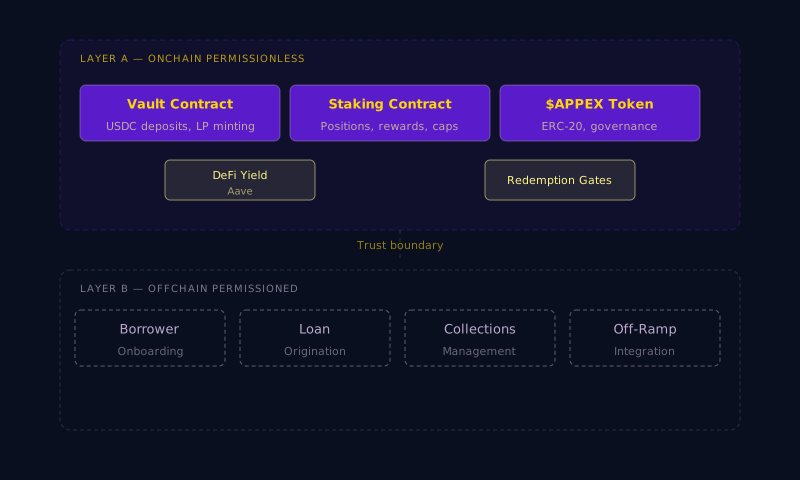
Layer A: Onchain Permissionless (LP-Facing)
The onchain vault is the liquidity engine. All operations are executed by smart contracts onchain.
- USDC deposits and LP token minting
- NAV calculation and continuous yield accrual
- Redemption processing with protective gates (daily caps, per-request limits)
- Capital not actively lent to borrowers is deployed to DeFi protocols (Aave, Compound) for continuous yield
- $APPEX staking, LP token locking, and reward distribution
Layer B: Offchain Permissioned (Credit Extension)
The offchain layer manages everything the blockchain should not: business relationships, credit underwriting, and fiat operations.
- Borrower onboarding with credit assessment, background checks, and financial review
- Loan origination against verified receivables
- Collections management and repayment tracking
- Fiat off-ramp integrations for non-crypto payouts
Why This Separation Matters
LPs face only the vault. They deposit USDC, receive LP tokens, and redeem shares. They have no direct exposure to individual receivables or borrower operations.
The vault faces the borrowers. Borrowers are responsible for repaying regardless of whether their own customers pay. If a borrower's customer defaults on a payment, the borrower still owes the vault. This insulates LPs from individual counterparty risk and simplifies the LP experience to a single decision: deposit capital, earn yield.
Info: Capital in the vault is always working. USDC not actively lent to borrowers is deployed to established DeFi lending protocols (Aave, Compound) for continuous yield. These positions are highly liquid and can be withdrawn instantly to fund redemptions or new advances. The only capital that cannot be immediately accessed is what is currently deployed in active borrower advances.
Built for Both Sides
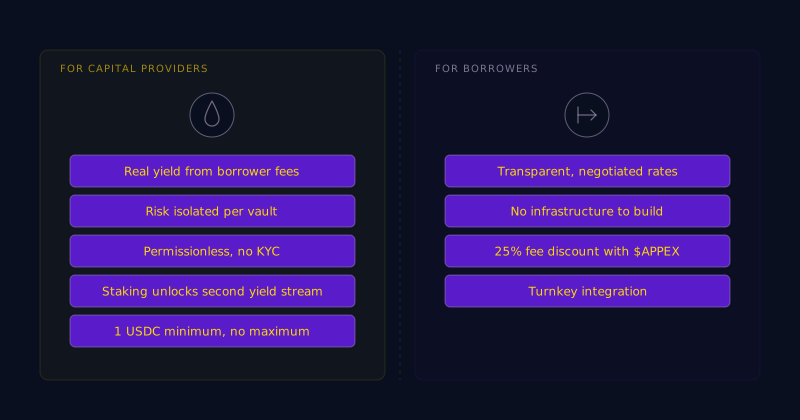
For Capital Providers
- Real yield backed by actual borrower fees, not token emissions or inflationary rewards
- Risk contained in isolated vault architecture where losses in one vault do not affect others
- Permissionless access with no mandatory lock-up for base yield
- $APPEX staking unlocks a second yield stream from protocol fee distributions
- 1 USDC minimum deposit. No maximum. No KYC.
For Borrowers
- Competitive capital access at transparent, individually negotiated rates based on payment terms, volume, and creditworthiness
- No custom infrastructure to build or maintain. No need to attract LPs or manage smart contracts.
- 25% fee discount when paying protocol fees in $APPEX
- Turnkey integration. Plug into existing vault liquidity and immediately offer accelerated payments to your users or suppliers.