

Fee Structure
This page documents every fee in the appeX Protocol: who pays, how much, where fees flow, and how the fee discount for $APPEX creates demand across the protocol.
Fee Components
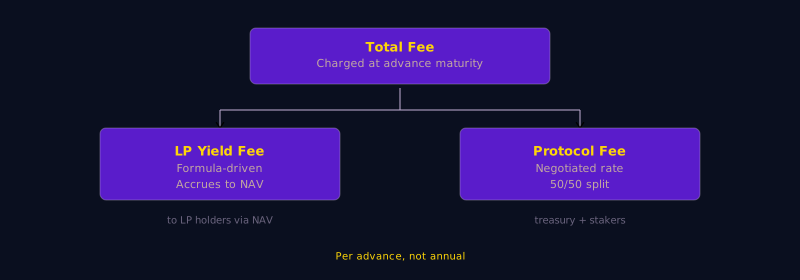
Each advance from the vault carries two fee components:
- LP Yield Fee - Paid by the borrower in USDC. Accrues to vault NAV. This is the direct return for Liquidity Providers.
- Protocol Fee - Paid by the borrower in USDC or $APPEX (at a 25% discount). Split 50/50 between the appeX Treasury and $APPEX stakers.
Together, these two fees represent the total cost a borrower pays for each advance. The LP yield fee is formula-driven and scales with payment term duration. The protocol fee is negotiated individually during onboarding.
LP Yield Fee
The LP yield fee compensates Liquidity Providers for the time their capital is deployed. The rate scales linearly with payment term duration. Longer terms mean LPs wait longer for repayment, so the fee is higher.
Fee Curve Formula
Fee = f_min + (f_max - f_min) × (d - d_min) ÷ (d_max - d_min)
Where:
- d — Payment term in days
- d_min — Minimum term (e.g., 30 days)
- d_max — Maximum term (e.g., 180 days)
- f_min — Minimum fee at shortest term (e.g., 5%)
- f_max — Maximum fee at longest term (e.g., 15%)
Fee curve parameters are set per vault and can be adjusted through governance. The examples below use fmin = 5%, fmax = 15%, dmin = 30, dmax = 180.
Fee Reference Table (Illustrative)
| Payment Terms | LP Yield Fee | Capital Turns per Year | Simple Annualized Yield |
|---|---|---|---|
| Net-30 | 5.0% | ~12x | ~60% |
| Net-60 | 7.0% | ~6x | ~42% |
| Net-90 | 9.0% | ~4x | ~36% |
| Net-120 | 11.0% | ~3x | ~33% |
| Net-150 | 13.0% | ~2.4x | ~31% |
| Net-180 | 15.0% | ~2x | ~30% |
Info: These figures are illustrative, not guaranteed returns. The source-documented example is 5% per advance at 4 turns per year (Net-90) producing roughly 20% annualized yield. The remaining rows extend this logic across different term lengths assuming full utilization and uniform payment terms. Actual results depend on vault utilization rate, the mix of borrower payment terms, and gaps between advances.
How LP Yield Accrues
The LP yield fee is not paid as a lump sum. It accrues incrementally over the advance's contractual term:
Example:
$10,000 advance × 9% LP yield fee = $900 fee (Net-90)
| Day | Daily Accrual | Cumulative |
|---|---|---|
| 1 | $10.00 | $10.00 |
| 30 | $10.00 | $300.00 |
| 60 | $10.00 | $600.00 |
| 90 | $10.00 | $900.00 |
Each day, $10.00 accrues to vault NAV. By maturity, the full $900 is reflected in NAV regardless of when cash arrives.
Protocol Fee
The protocol fee is an additional charge on top of the LP yield fee. Unlike the LP yield fee, which is formula-driven, the protocol fee is negotiated individually with each borrower. It funds protocol operations and rewards $APPEX stakers.
Key Characteristics
- Negotiated individually with each borrower during onboarding
- Varies by borrower based on volume, creditworthiness, and strategic importance to the protocol
- Payable in USDC or $APPEX (25% discount when paid in $APPEX)
Higher protocol fees benefit LPs who stake $APPEX, because more protocol fee revenue means more $APPEX purchased and distributed to stakers. Borrowers paying higher protocol fees also have stronger incentives to integrate $APPEX on their platforms, since the 25% discount means larger absolute savings when paying in tokens.
Total Fee Calculation
Total Fee = LP Yield Fee(d) + Protocol Fee(negotiated)
Example with 2% protocol fee:
| Payment Terms | LP Yield | Protocol Fee | Total Fee |
|---|---|---|---|
| Net-30 | 5.0% | 2.0% | 7.0% |
| Net-60 | 7.0% | 2.0% | 9.0% |
| Net-90 | 9.0% | 2.0% | 11.0% |
| Net-120 | 11.0% | 2.0% | 13.0% |
| Net-150 | 13.0% | 2.0% | 15.0% |
| Net-180 | 15.0% | 2.0% | 17.0% |
Protocol Fee Distribution
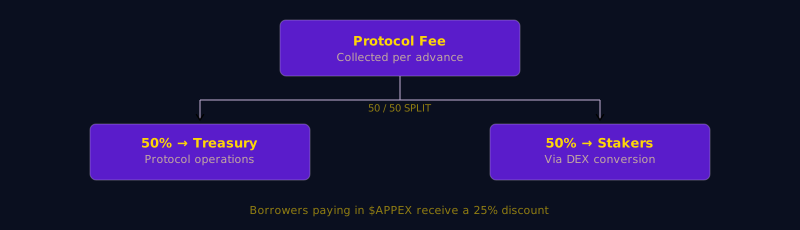
Protocol fees split evenly between two destinations:
| Destination | Share | Mechanism |
|---|---|---|
| appeX Treasury | 50% | Funds protocol development, operations, and growth |
| $APPEX Stakers | 50% | Converted to $APPEX via DEX purchase, distributed to stakers |
When Paid in USDC
- 50% flows to Treasury
- 50% is used to purchase $APPEX on a DEX
- Purchased $APPEX is distributed to stakers proportionally
When Paid in $APPEX (25% Discount)
- 50% of $APPEX flows to Treasury
- 50% of $APPEX transfers directly to staking contract. No DEX purchase needed.
- Borrower pays 75% of the USDC-equivalent protocol fee
Example: If the protocol fee is 2% on a $10,000 advance:
| Payment Method | Fee Amount | Effective Cost |
|---|---|---|
| USDC | $200 | $200 |
| $APPEX | $150 worth of $APPEX | $150 (25% savings) |
Warning: The 25% discount applies only to the protocol fee, not the LP yield fee. LP yield fees are always paid in USDC and always accrue fully to vault NAV.
Fee Flow Summary
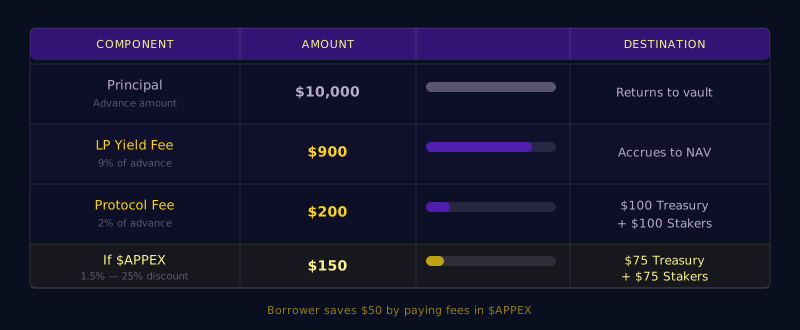
The following examples show the complete fee flow for a $10,000 advance at Net-90 with a 2% protocol fee.
Borrower draws $10,000 at Net-90 with 2% protocol fee:

LP Yield Fee (9%)   $900   → Accrues to Vault NAV → Benefits all LPs
Protocol Fee (2%)   $200   → $100 to Treasury + $100 buys $APPEX for stakers

Total borrower cost: $1,100
If the borrower pays the protocol fee in $APPEX:

LP Yield Fee (9%)    $900            → Accrues to Vault NAV → Benefits all LPs
Protocol Fee (1.5%)  $150 of $APPEX  → $75 to Treasury + $75 to stakers

Total borrower cost: $1,050  (saved $50)
The LP yield fee is identical in both scenarios. LP economics are preserved regardless of how the borrower pays the protocol fee. The discount only affects the protocol fee portion and is designed to incentivize $APPEX accumulation and usage by borrowers.
When fees are paid in USDC, the staker portion routes through a DEX to purchase $APPEX, creating structural buying pressure. When fees are paid in $APPEX, the tokens transfer directly to the staking contract, cycling through the protocol rather than being sold. Both paths benefit $APPEX stakers.