

Key Concepts
This page defines the core concepts used throughout the appeX documentation. Each term is explained with context on why it matters to the protocol's design. For a complete terminology reference, see the Glossary.
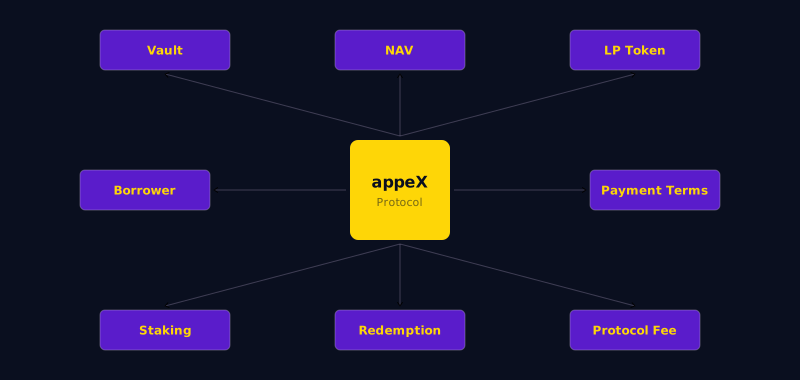
Vault
An isolated smart contract that holds USDC deposits, manages NAV, and facilitates borrower draws and LP redemptions. Each vault operates with its own fee structure, risk profile, borrower pool, and staking multiplier.
Capital does not flow between vaults.
Why isolation matters. Different industries carry different risk profiles. Ad receivables behave differently than trade invoices, which behave differently than SaaS contracts. If a borrower defaults in one vault, the loss is contained to that vault's LPs. Other vaults are unaffected. This lets LPs choose their risk exposure and deposit into vaults matching their appetite.
The initial vault serves multiple approved borrowers under a unified lending structure. Future vaults will be established through governance to isolate different industries, geographies, or risk categories. While each vault isolates capital and risk, the $APPEX staking contract sits centrally across all vaults.
Net Asset Value (NAV)
The total value of assets held by a vault: DeFi-deployed USDC + lent USDC + accrued fees - bad debt reserves. NAV determines LP token price and is updated continuously, not through daily snapshots.
Calculated as:
NAV = USDC_DeFi + USDC_lent + Accrued_Fees + DeFi_Yield_Accrued - Bad_Debt_Reserve
NAV determines the price of LP tokens. As borrowers repay with fees, NAV increases and LP token value appreciates. As bad debt is recognized, NAV decreases and LP token value drops.
Why continuous NAV matters. Traditional fund structures use daily NAV snapshots with fixed update windows. This creates predictable timing that can be exploited: depositing right before a NAV jump, or redeeming before a loss is posted. appeX eliminates this by making NAV effectively continuous. Every deposit or redemption triggers an internal NAV refresh before pricing shares.
LP Token
A transferable ERC-20 token minted when USDC is deposited into a vault. Represents proportional ownership of vault NAV. Appreciates in value as borrower fees accrue.

Each LP token can be held for base yield, locked into the staking contract for additional rewards, or traded on secondary markets.
LP tokens serve two purposes. First, they provide base yield passively. As borrower fees accrue to NAV, the share price increases, and LP tokens appreciate in value. No action is required. Second, LP tokens can be locked into the staking contract alongside $APPEX to earn additional protocol fee distributions.
Because LP tokens are standard ERC-20s, they can be transferred, traded on secondary markets, or used in DeFi compositions. However, LP tokens locked in the staking contract cannot be transferred until the staking position is closed.
Worked example. A vault starts with 100,000 USDC and 100,000 LP tokens outstanding at a $1.00 share price. Borrowers repay with $10,000 in fees. NAV rises to 110,000 USDC. Share price rises to $1.10. A new LP who deposits 10,000 USDC receives 9,090.91 shares (10,000 / $1.10). The vault now holds 120,000 USDC with 109,090.91 shares outstanding. Share price remains $1.10. Deposits and withdrawals do not affect share price. Only accrued fees and bad debt adjustments change it.
Approved Borrower
A company that has passed appeX onboarding (credit evaluation, financial review, compliance verification) and is authorized to draw capital from the vault. The borrower is responsible for repayment regardless of downstream outcomes.

Once approved, the borrower can draw USDC from the vault under their individually negotiated terms.
When drawing capital, borrowers choose their format: $APPEX (USDC routes from the vault to a DEX for token purchase) or USDC (direct transfer). Every $APPEX draw creates structural buying pressure from real business activity, giving the token demand tied to actual capital deployment rather than speculation.
The borrower is responsible for repaying principal plus fees regardless of how they deploy the capital downstream. If the borrower's customer fails to pay an invoice, the borrower still owes the vault. This is the critical risk transfer that protects LPs. It also means the vault does not need to track individual receivables or assess downstream counterparties.
What happens on default. If a borrower fails to repay on schedule, the advance enters a grace period (e.g., 5 days) where yield accrual stops but accrued value is preserved. If the borrower still does not pay after the grace period, the advance is impaired. Insurance coverage is applied where available, and any remaining shortfall is written down against vault NAV. The borrower loses vault access.
Payment Terms
The duration (in days) between capital deployment and expected repayment. Typically Net-30 to Net-180. Longer terms carry higher LP yield fees.
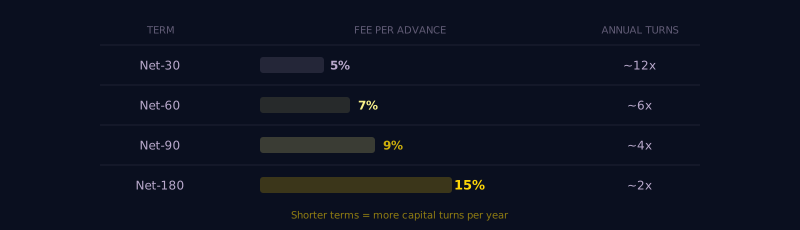
Why terms drive fees. Longer payment terms mean capital is deployed for a longer period, so fees are higher to compensate LPs accordingly. Shorter-term borrowers pay less, creating an incentive for faster repayment cycles. Exact rates are negotiated individually per borrower based on term duration, volume, and creditworthiness. For example, a Net-30 advance might carry a 5% fee while a Net-180 advance might carry a 15% fee.
The relationship between terms and effective annual yield is inverse but important. Shorter terms generate lower per-advance fees but allow capital to turn more frequently. For example, at Net-30 with a 5% fee, capital can turn roughly 12 times per year. At Net-180 with a 15% fee, capital turns roughly twice. The effective annualized yield depends on the mix of payment terms across all active advances.
Protocol Fee
An additional fee charged to borrowers on top of the LP yield fee. Negotiated individually per borrower during onboarding. Split 50/50 between the appeX Treasury and $APPEX stakers. Payable in USDC or $APPEX (at 25% discount).
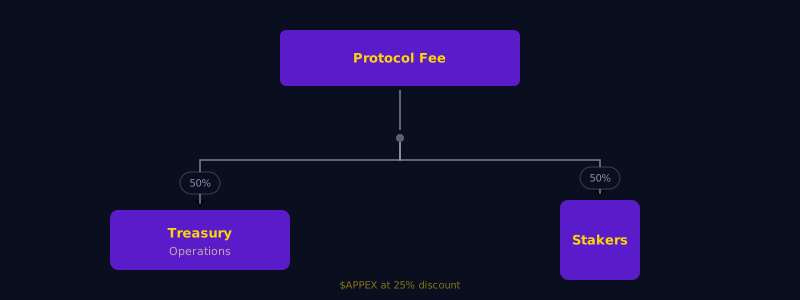
Protocol fees split evenly:
- 50% to the appeX Treasury, funding protocol development and operations
- 50% converted to $APPEX and distributed to stakers
Borrowers can pay protocol fees in $APPEX at a 25% discount. This creates a direct incentive for borrowers to accumulate and hold $APPEX, and it creates a sustainable cycle where tokens flow through the protocol rather than being sold on the open market.
The protocol fee is separate from the LP yield fee. LP economics are preserved regardless of how the borrower pays the protocol fee.
Staking
The process of locking LP tokens and $APPEX into the staking contract to earn protocol fee distributions. Rewards are proportional to the amount staked and the lock duration multiplier chosen. Only LPs can stake.
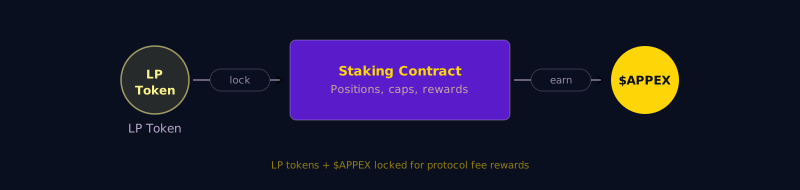
LPs lock both LP tokens and $APPEX into a unified staking contract. The amount of $APPEX eligible for rewards is hard-capped by the number of LP tokens locked multiplied by the vault multiplier.
Why the cap exists. Without a cap, someone could lock minimal USDC, mint a few LP tokens, then stake a large $APPEX position and capture disproportionate fee distributions. The cap ensures that staking rewards flow to participants who have committed real capital to the vault, not to speculative token holders.
LPs choose a lock duration. No lock earns rewards at 1.0x weight. A 3-month lock earns at 2.0x weight. A 6-month lock earns at 3.0x weight. Longer commitments earn a proportionally larger share of protocol fee distributions. Once locked, neither the LP tokens nor the $APPEX can be withdrawn until the lock period expires.
Redemption
The process of withdrawing USDC from a vault by burning LP tokens at the current share price. Processed through three gates: daily cap, available liquidity check, and per-request limit.
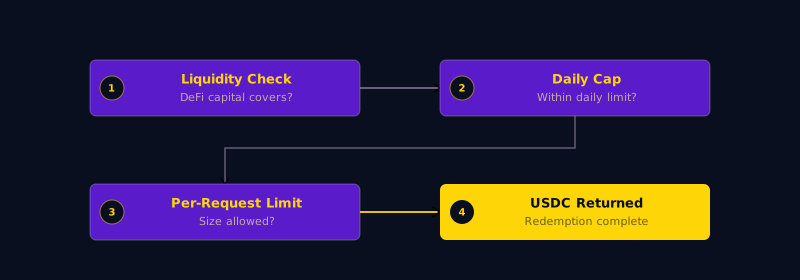
Redemptions are processed through a gated system designed to protect vault liquidity and ensure fair treatment of all LPs:
- Available liquidity check: If DeFi-deployed capital (Aave, Compound) covers the requested amount, the redemption is facilitated instantly. If insufficient liquidity is available, the full request is queued until liquidity becomes available. The user is notified of the available amount and can choose to lower their request to match available liquidity or queue the full amount.
- Daily redemption cap: A policy cap limits total daily exits as a percentage of vault supply. If the daily cap has been reached, new redemption requests are rejected (not queued) until the next processing window. This prevents a rush of withdrawals from depleting liquidity in a single day.
- Per-request limit: An optional cap preventing a single large LP from consuming all available liquidity, protecting smaller LPs from being crowded out.
Queued requests are serviced by FIFO as repayments land or new deposits arrive. If the daily redemption cap has been reached, additional requests are rejected outright until the next processing window. The vault does not liquidate outstanding borrower advances to service redemptions. Advances mature on their contractual timeline.
Accrual-Based Yield
A method of recognizing yield incrementally over the life of an advance rather than as a lump sum when cash is received. This prevents late-entering LPs from capturing yield they did not earn.
Rather than recognizing yield only when cash arrives, appeX accrues yield incrementally over the life of each advance. For a $100 advance with a $10 fee over 30 days, approximately $0.33 accrues to NAV each day.
Why this matters. Without accrual, an LP could deposit at Day 89 of a 90-day advance and capture the full $10 fee when the borrower repays on Day 90, even though their capital was only in the vault for 1 day. With accrual, $9.67 of the fee is already reflected in NAV by Day 89. The late-entering LP buys shares at the higher price and only benefits from the remaining $0.33. This ensures every LP is compensated for exactly the time their capital was deployed.
Tip: New to DeFi concepts? The Glossary defines every technical term used in this documentation, from "smart contract" to "NAV" to "utilization."