

Staking
This page documents the $APPEX staking mechanism: how it works, who can participate, how rewards are calculated, how the cap system prevents gaming, and how staking interacts with the multi-vault architecture.
Purpose
$APPEX staking allows LPs to earn protocol fee distributions on top of their base vault yield. It also reduces circulating supply, which creates confidence for recipients receiving $APPEX payouts. When recipients see that LPs have committed both capital (USDC) and tokens ($APPEX) with lock mechanics in place, it signals long-term alignment across the protocol.
The mechanism is designed with one critical constraint: only real liquidity providers can earn staking rewards.
Without this constraint, a participant could lock minimal USDC, mint a few LP tokens, then stake a large $APPEX position and capture disproportionate fee distributions. The cap system prevents this by tying staking capacity directly to LP token holdings.
How It Works
Requirements
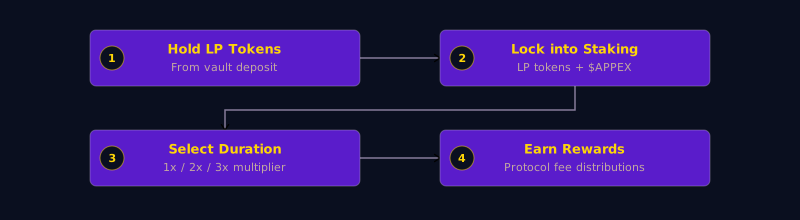
To participate in staking, an LP must:
- Hold LP tokens from one or more vaults
- Lock LP tokens into the staking contract
- Stake $APPEX tokens against locked LP tokens
- Select a lock duration (No Lock, 3 months, or 6 months)
The Cap System

The amount of $APPEX eligible for rewards is hard-capped by the number of LP tokens locked.
Per-Vault Cap:
APPEX_cap_vault = LP_tokens_locked × Vault_Multiplier
Total Cap:
APPEX_cap_total = Sum of APPEX_cap_vault across all vaults
Any $APPEX staked above the total cap does not earn rewards. It remains in the staking contract but is tagged as non-rewarding.
Vault Multipliers
Different vaults carry different multipliers, reflecting their risk and capital commitment profiles:
| Vault | Multiplier | Effect |
|---|---|---|
| Vault 1 | 2× | 1,000 locked LP tokens → 2,000 $APPEX cap |
| Future vaults | Set by governance | Multipliers calibrated to vault risk profile |
Lock Duration Multipliers
Longer lock commitments earn higher reward weight:
| Lock Duration | Duration Multiplier | Effect |
|---|---|---|
| No Lock | 1.0× | Base reward weight |
| 3 months | 2.0× | 2× reward weight |
| 6 months | 3.0× | 3× reward weight |
Staking Cap Example
Setup:
- LP locks 1,000 LP tokens in Vault 1 (multiplier: 2×)
Cap calculation:
- Cap from Vault 1: 1,000 × 2 = 2,000 $APPEX
Result: This LP can stake up to 2,000 $APPEX for rewards. Any amount above 2,000 is accepted by the contract but tagged as non-rewarding.
With multiple vaults:
- LP locks 1,000 LP tokens in Vault 1 (2×) = 2,000 $APPEX cap
- LP locks 500 LP tokens in Vault 2 (3×) = 1,500 $APPEX cap
- Total cap: 3,500 $APPEX
Staking Above the Cap
If a user stakes more $APPEX than their cap allows:
| Scenario | Result |
|---|---|
| Staked ≤ Cap | All tokens earn rewards |
| Staked > Cap | Eligible portion earns rewards; excess is staked but non-rewarding |
The contract accepts the full stake but only the eligible portion (up to cap) earns distributions.
Reward Distribution
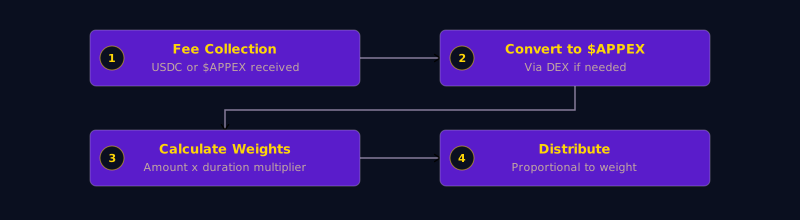
Rewards are distributed monthly, aligned with typical borrower repayment cycles.
Step 1: Fee Collection
Protocol fees flow into the staking contract in USDC or $APPEX (from borrowers who pay in $APPEX at the 25% discount).
Step 2: Conversion
If fees arrive in USDC, the contract swaps for $APPEX on a DEX. If fees arrive in $APPEX, no conversion is needed.
Step 3: Weight Calculation
For every active staking position:
Position Weight = APPEX_staked_effective × Duration_Multiplier
Total Weight = Sum of all Position Weights
Step 4: Proportional Distribution
Reward = Epoch_Rewards × (Position_Weight / Total_Weight)
Rewards are added to each user's unclaimed $APPEX balance. Users can claim at any time.
Worked Example
Epoch rewards: 10,000 $APPEX
| User | $APPEX Staked | Lock Duration | Multiplier | Position Weight |
|---|---|---|---|---|
| Alice | 1,000 | 6 months | 3.0× | 3,000 |
| Bob | 2,000 | 3 months | 2.0× | 4,000 |
| Carol | 1,500 | 6 months | 3.0× | 4,500 |
Total weight: 3,000 + 4,000 + 4,500 = 11,500
| User | Calculation | Reward |
|---|---|---|
| Alice | 10,000 × (3,000 / 11,500) | 2,608.70 $APPEX |
| Bob | 10,000 × (4,000 / 11,500) | 3,478.26 $APPEX |
| Carol | 10,000 × (4,500 / 11,500) | 3,913.04 $APPEX |
Position Lifecycle
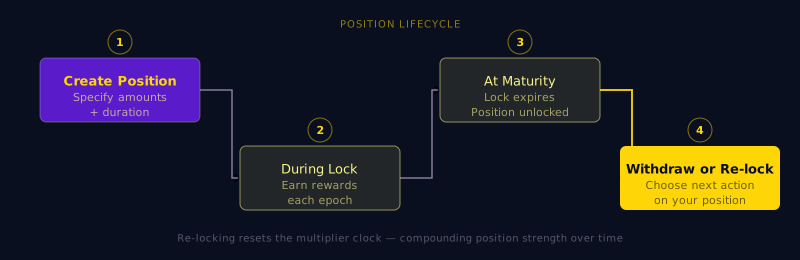
Creating a Position
User specifies:
- Amount of $APPEX to stake
- Associated LP tokens to lock
- Lock duration (No Lock, 3 months, or 6 months)
The contract stores the position with effective amount, lock timestamps, and duration multiplier.
During Lock
The position earns rewards every epoch based on its weight. Locked LP tokens continue to track vault NAV movements. Economic exposure is maintained even while locked.
Locked LP tokens cannot be redeemed while $APPEX is staked against them. To redeem, the LP must first reduce their $APPEX stake.
At Maturity
When the lock period expires, the position stops earning new rewards. The user can:
- Withdraw staked $APPEX
- Claim unclaimed rewards
- Create a new lock with some or all $APPEX
Early Exit
Not permitted. Once locked, $APPEX cannot be withdrawn until the lock duration expires. This protects the integrity of the reward multiplier system and ensures stakers who commit for longer periods receive higher rewards as intended.
LP Token Changes and Cap Adjustments
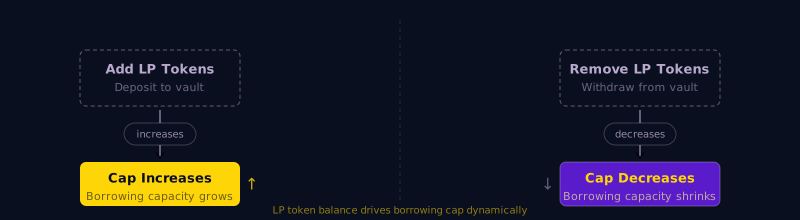
Staking capacity is dynamic. As LP positions change, the cap adjusts automatically.
Adding LP Tokens
When a user locks additional LP tokens:
- Vault-specific cap increases
- Total cap increases
- User can create new staking positions up to the new cap
- No impact on existing staking positions
Removing LP Tokens
When a user unlocks LP tokens:
- Vault-specific cap decreases
- Total cap decreases
- If effective staked $APPEX exceeds the new cap, the excess portion stops earning rewards immediately
This creates a natural incentive to maintain LP positions. Withdrawing from the vault directly reduces staking capacity and the share of protocol fee distributions the LP receives.
Multi-Vault Staking
The staking contract sits centrally across all vaults. This is a key architectural decision. While each vault isolates capital and risk, staking is unified.
LPs can lock LP tokens from multiple vaults simultaneously. The total staking cap is the sum of caps across all vaults:
- Vault 1: 1,000 LP tokens x 2x multiplier = 2,000 $APPEX cap
- Vault 2: 500 LP tokens x 3x multiplier = 1,500 $APPEX cap
- Total cap: 3,500 $APPEX
As the protocol launches new vaults, each new vault creates new staking capacity. This means demand for $APPEX staking grows as the protocol grows. Each new vault absorbs tokens into productive, locked positions rather than exchange sell pressure.
The LP Game Theory
The optimal strategy for an LP unfolds in stages:
- Deposit USDC into the vault. Receive LP tokens.
- Stake $APPEX up to the quantity cap. Lock for 6 months to maximize multiplier.
- Earn base yield from vault NAV appreciation plus $APPEX distributions from staking.
- As NAV grows, LP tokens become worth more USDC. As $APPEX price moves, staked positions change in dollar terms.
- When the staking cap in one vault is fully used, provide liquidity to a new vault, lock fresh LP tokens, and stake additional $APPEX.
Market dynamics drive these decisions, not the protocol. The protocol provides the mechanics. LPs decide where to allocate capital based on risk, yield, and opportunity.
Warning: Staking involves locking both LP tokens and $APPEX for a minimum duration. During the lock period, neither the LP tokens nor the $APPEX can be withdrawn. Ensure you understand the liquidity implications before committing to a lock. See Risk Framework for staking-related risks.