The Capital Gap
The gap between earning revenue and receiving cash is the single largest drag on business growth worldwide. appeX exists to close it.
Earned but Not Received
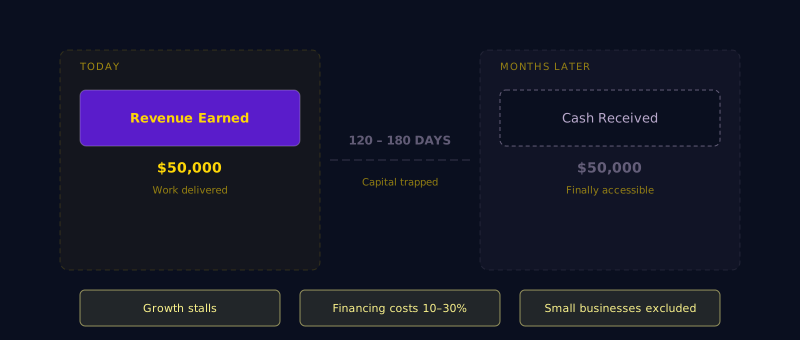
Across industries, businesses deliver value today and wait months to get paid. A publisher serves ad impressions in January and might not see cash until May or June. A manufacturer ships product and waits 60 to 90 days for payment. A SaaS vendor completes implementation and waits for quarterly billing cycles to catch up.
The revenue is earned. It appears on balance sheets as a receivable. But it cannot be spent, deployed, or reinvested until cash actually arrives.
Consider a mobile game studio serving 10 million ad impressions in a month at a $5 CPM. That is $50,000 in earned revenue. Under typical payment terms from a major advertiser, that money might not arrive for 120 to 180 days. In the meantime, the studio still needs to pay developers, fund user acquisition campaigns, and cover server costs. The revenue exists. It is just trapped in someone else's cash flow cycle.
This creates three compounding problems:
- Growth stalls. Hiring, inventory, marketing, user acquisition. All delayed until cash lands. Companies make decisions based on cash on hand, not revenue earned.
- Financing is expensive. Traditional factoring charges 10 to 30% of the receivable value to accelerate capital. Invoice discounting penalizes the supplier. These costs often exceed the profit margin on the underlying transaction.
- Small businesses suffer disproportionately. Companies without credit lines or banking relationships absorb the full weight of delayed payments. Well-funded competitors can weather the delay. Bootstrapped teams cannot. The payment timing problem systematically favors incumbents regardless of product quality.
The Scale of the Problem
The capital gap is not niche. It is structural across the global economy.
| Industry | Typical Payment Terms | Annual Volume Affected |
|---|---|---|
| Digital Advertising | Net-60 to Net-180 | Industry estimates suggest $600B+ in global ad spend |
| Manufacturing | Net-30 to Net-90 | Industry estimates suggest $13T+ in global manufacturing output |
| Logistics & Freight | Net-30 to Net-60 | Industry estimates suggest $9T+ in global logistics spend |
| Enterprise SaaS | Net-30 to Net-90 | Industry estimates suggest $300B+ in enterprise software market |
Payment terms are not negotiated on equal footing. Large buyers hold significant leverage. They can demand extended payment terms because suppliers need access to their budgets. The power flows one direction. Suppliers who push back risk losing contracts to competitors willing to accept longer waits.
Intermediaries compound the problem. Even when a buyer pays on Net-60 terms, each intermediary in the chain adds processing time. A Net-60 term from the buyer can translate to Net-120 or longer for the supplier.
Info: The trade and receivables financing market exceeds $2.7T annually. It remains heavily intermediated, expensive, and inaccessible to most businesses globally.
Why Traditional Finance Fails Here
Traditional receivables financing is built on bilateral relationships, manual underwriting, and opaque fee structures. It requires:
- Relationship-based access through banks, factors, or specialty lenders
- High minimum transaction sizes that exclude smaller businesses entirely
- Processing times measured in weeks, not hours
- Ongoing compliance overhead that adds cost at every step
The cost of capital acceleration through these channels ranges from 10 to 30% of the receivable value. For a supplier operating on thin margins, paying 15% to access money already owed can eliminate profitability entirely.
Previous blockchain solutions attempted to address this but required suppliers to change their workflows: managing wallets, dealing with volatility, understanding DeFi mechanics. That is a non-starter for businesses focused on running their operations.
The solution needs to meet businesses where they are while giving them what they need: immediate liquidity with complete optionality.
The appeX Approach
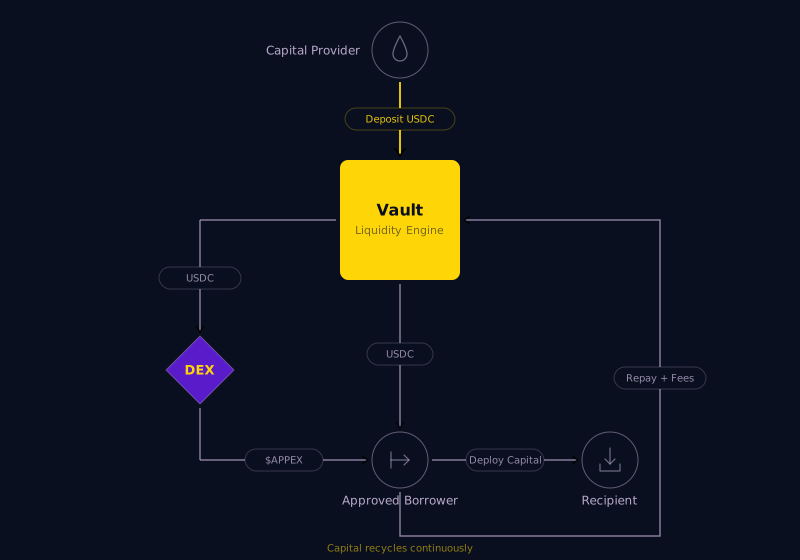
appeX replaces this infrastructure with a programmable liquidity vault onchain.
- Capital providers deposit USDC and earn yield from real borrower fees. No KYC required. Access is permissionless.
- Pre-approved borrowers draw capital in $APPEX or USDC, their choice. $APPEX draws route through a DEX, creating real buying pressure. USDC draws transfer directly. Fee structures are negotiated per borrower based on payment term duration, volume, and creditworthiness.
- End recipients receive funds downstream in their preferred format: $APPEX tokens, USDC, fiat, or any combination.
- $APPEX creates systematic alignment between all participants through payment backing, staking rewards, fee discounts for borrowers, and governance rights over protocol parameters.
The vault operates continuously. Capital deployment and repayment happen programmatically. Rates are determined by payment term duration and borrower profile, not relationship leverage. The fee structure is transparent and consistent for each borrower regardless of whether they process $100,000 or $100 million in volume.