

Borrower Framework
This page describes how companies become approved borrowers, how they draw capital from the vault, how repayment works, and what happens when things go wrong.
Why Companies Borrow
Borrowing from the vault is a competitive advantage. Consider a company competing for supplier or publisher relationships. One offers Net-60 payment terms. The other offers instant settlement through appeX. Suppliers and publishers choose the instant option because cash flow constraints are real and immediate.
The company borrowing from appeX attracts more suppliers. More suppliers means more transaction volume. More volume means more revenue. This is why companies pay fees to access the vault. Building instant payment infrastructure from scratch requires designing and auditing smart contracts, attracting liquidity providers, managing LP relationships, creating risk management frameworks, and maintaining ongoing operations. appeX has already solved all of this. Companies plug in and immediately offer accelerated settlements.
Borrower Onboarding
Vault access is permissioned. Every borrower undergoes a structured evaluation before receiving approval to draw capital.
Evaluation Process
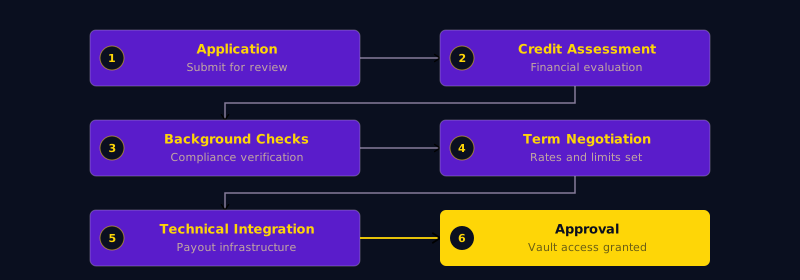
- Application. Company submits application with financial statements, business model documentation, and customer payment data.
- Credit Assessment. appeX evaluates the company's creditworthiness, revenue history, customer concentration, and payment term patterns. The assessment focuses on the company's ability to repay, not the creditworthiness of individual downstream counterparties.
- Background Checks. Compliance verification including corporate identity, beneficial ownership, and regulatory standing.
- Term Negotiation. Borrowing limit, payment term range, LP yield fee parameters, and protocol fee rate are agreed upon. Terms reflect the borrower's margins, payment velocity, creditworthiness, and strategic value to the protocol.
- Technical Integration. Borrower integrates payout infrastructure for $APPEX, USDC, and fiat distribution to their downstream recipients. Optional but incentivized: integration of $APPEX as a payment method within the borrower's platform.
- Approval. Borrower gains the ability to draw from the vault within their approved limit.
Borrower Prioritization
Not all potential borrowers are equal. When vault liquidity is limited, appeX prioritizes companies based on:
- Fee generation. Companies with higher margins or willingness to pay higher fees generate more value for LPs.
- Payment velocity. Companies whose customers pay quickly enable faster capital turns and higher effective yields.
- $APPEX integration. Companies willing to accept $APPEX within their platforms increase token utility and expand the distribution surface area.
- Credit quality. Companies with strong balance sheets and reliable repayment history reduce vault risk.
Info: Borrower onboarding is deliberately rigorous. The vault's risk profile is only as strong as the quality of its approved borrowers. See Risk Framework for how borrower default risk is managed.
How Borrowers Use the Vault
Once approved, a borrower can draw USDC from the vault to fund their operations. The vault does not prescribe how capital is deployed downstream. That is the borrower's decision.
Common Use Cases
| Use Case | How the Borrower Deploys Capital |
|---|---|
| Instant payouts | Company pays its publishers or suppliers immediately instead of waiting Net-30 to Net-180 terms |
| Reverse invoice factoring | Company settles supplier invoices early, unlocking working capital across the supply chain |
| Supplier payments | Accelerated payment to supply chain partners to strengthen relationships and secure better terms |
The flexibility is intentional. The vault is capital infrastructure. How borrowers deploy that capital depends on their business model, their customers, and their market.
The Borrower's Obligation
Regardless of the downstream use case, the borrower's obligation to the vault is the same:
- Repay principal in USDC. This is the amount drawn from the vault.
- Pay LP yield fee calculated by the fee curve based on payment term duration (e.g., 5% at Net-30, scaling to 15% at Net-180).
- Pay protocol fee negotiated per borrower during onboarding. Payable in USDC or $APPEX at a 25% discount.
The borrower is responsible for repayment even if their own customer fails to pay. This is the critical risk transfer that protects LPs. It also creates a strong incentive for borrowers to maintain their own credit assessment and collections processes.
The Advance Lifecycle
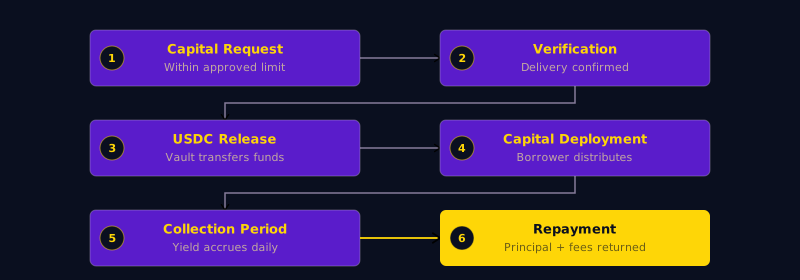
1. Capital Request
Borrower submits a draw request specifying the amount and associated payment terms.
2. Verification
The borrower's internal systems verify that the underlying value has been delivered: ad impressions served, goods shipped, services completed. Only verified receivables are eligible for advances.
3. USDC Release
The vault releases USDC to the borrower. The advance is recorded with:
- Principal amount
- LP yield fee (based on payment term and fee curve)
- Expected repayment date
- Associated protocol fee
4. Capital Deployment
The borrower deploys capital according to their business needs. Recipients may receive funds in multiple formats:
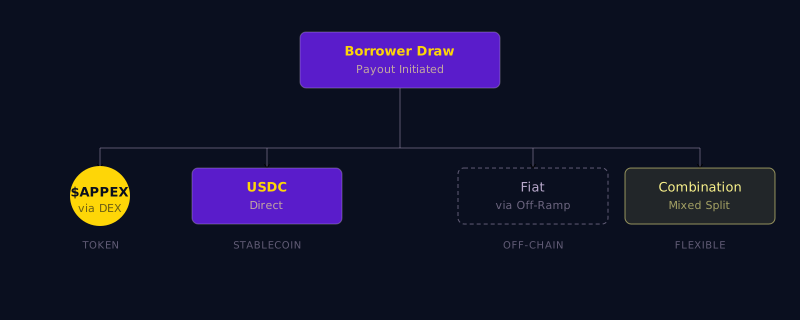
- $APPEX tokens. USDC routes to a DEX, purchases $APPEX, and tokens transfer to the recipient's wallet.
- USDC. Stablecoins transfer directly to the recipient's wallet.
- Fiat. USDC routes through off-ramp partners for bank deposit (1-3 business days).
- Any combination. Recipients can split payouts across formats in any proportion.
5. Collection Period
Time passes according to the borrower's original payment terms with their customer (Net-30 to Net-180). During this period, the LP yield fee accrues incrementally to vault NAV.
6. Repayment
When the borrower's customer pays:
- Borrower repays vault principal + LP yield fee in USDC
- Borrower pays protocol fee in USDC or $APPEX (25% discount)
- LP yield fee is realized in vault NAV
- Protocol fee splits 50/50: Treasury and $APPEX stakers
- Capital becomes available for new advances
Default Handling
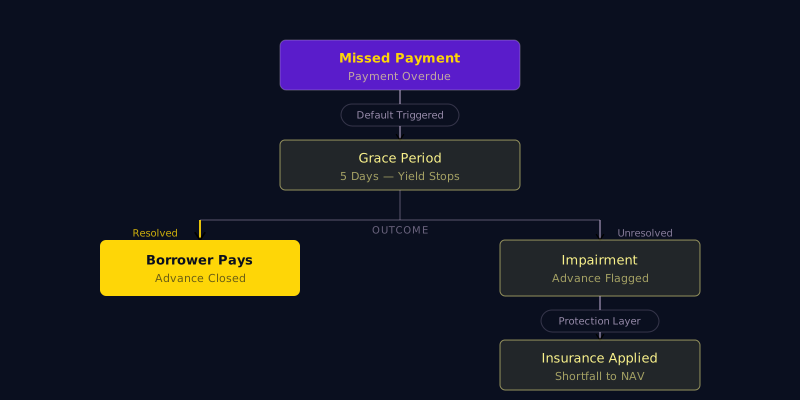
If a borrower fails to repay on schedule:
Grace Period (e.g., 5 days)
- Yield accrual stops on the affected advance
- NAV holds flat. Accrued value is preserved but does not grow.
- Advance marked as overdue but not impaired
After Grace Period
Scenario A: Borrower pays in full. Cash arrives late. NAV is unchanged because cash replaces the accrued receivable. Vault liquidity improves. All parties whole.
Scenario B: Borrower does not pay. This is a default event. The advance is impaired:
- Insurance coverage applied if available
- Remaining shortfall written down against vault NAV
- Loss socialized across LP shares proportionally
- Borrower loses vault access
Warning: Borrower defaults reduce vault NAV and LP token value. appeX mitigates this through rigorous onboarding, concentration limits, and insurance coverage where available. However, default risk cannot be eliminated entirely. See Risk Framework for a complete risk assessment.
Fast Repayment Incentives
Borrowers have a direct motivation to collect receivables quickly.
When their customers pay faster, capital returns to the vault sooner. This enables another advance earning another fee. Faster collections mean more capital turns per year, compounding yields for LPs. Borrowers benefit too: faster turnover means they can access the vault more frequently within their borrowing limit.
Consider a $100,000 advance against a Net-90 receivable. If collection happens at day 60 instead of day 90, the principal returns to the vault 30 days earlier. That capital can fund another advance earning another fee. Borrowers employ their own collection practices: payment reminders, early payment incentives, credit assessment of their own customers. The vault benefits from their operational discipline.