

Liquidity Providers
This page covers the full LP experience: how deposits work, how yield accrues, the two revenue streams available, and how LPs participate in the protocol over time.
The LP Value Proposition
LPs deposit USDC into the vault and earn yield from borrower fees. This yield comes from real economic activity: companies paying for access to capital. It is not funded by token emissions or inflationary rewards. When a borrower pays 9% on a Net-90 advance, that fee accrues directly to vault NAV and benefits every LP proportionally.
| Feature | Detail |
|---|---|
| Deposit asset | USDC |
| Access | Permissionless (no KYC/KYB) |
| Minimum deposit | 1 USDC |
| Maximum deposit | No hard cap |
| Yield source | Borrower fees per advance, scaled by payment term duration (e.g., 5-15%) |
| Additional yield | $APPEX staking rewards from protocol fees |
| DeFi yield | All unborrowed capital deployed to Aave and Compound for continuous yield |
| Lock-up requirement | None for base yield. 3 or 6 month lock for staking rewards. |
Two Revenue Streams
LPs can earn from two sources simultaneously:
- Base yield from vault NAV appreciation. Passive. No action required after depositing. As borrowers draw and repay, fees accrue to NAV and LP token value increases.
- Staking rewards from protocol fee distributions. Active. Requires locking LP tokens and $APPEX into the staking contract. LPs who stake receive $APPEX distributions from protocol fees on top of base yield.
The first stream is available to every LP. The second stream is available only to LPs who commit $APPEX alongside their liquidity.
Deposit Process
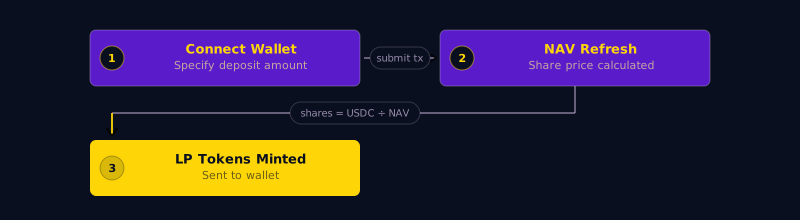
Step 1: Connect and Deposit
LP connects a wallet and specifies the USDC amount to deposit. The process is entirely permissionless with no explicit KYC or KYB requirements.
Compliance is enforced at the frontend layer:
- Geographic restrictions - Geofencing blocks access from prohibited regions
Step 2: Share Calculation
The vault refreshes NAV to ensure current pricing, then calculates LP tokens to mint:
Share Price = NAV / Total Shares Outstanding
Shares Minted = Deposit Amount / Share Price
Step 3: LP Tokens Issued
LP tokens are minted and sent to the depositor's wallet. These tokens:
- Represent proportional ownership of vault NAV
- Are transferable ERC-20 tokens
- Appreciate in value as borrower fees accrue to NAV
- Can be locked into the staking contract for additional rewards
- Can be traded on secondary markets or used in DeFi compositions
Worked Example
Initial state:
- Vault NAV: 100,000 USDC
- Shares outstanding: 100,000
- Share price: $1.00
After yield accrues:
- Borrowers repay with $10,000 in fees
- NAV increases to 110,000 USDC
- Share price rises to $1.10 (110,000 / 100,000)
New LP deposits 10,000 USDC:
- Receives 9,090.91 shares (10,000 / $1.10)
- Vault NAV: 120,000 USDC
- Total shares: 109,090.91
- Share price unchanged: $1.10
The new LP pays $1.10 per share, which reflects yield already earned by existing LPs. The new LP only benefits from yield generated after their deposit.
Info: Deposits and withdrawals do not affect share price. Only realized repayments (with yield) and bad debt adjustments change the share price. This is a fundamental property of the NAV-based model.
How Yield Accrues
LP yield comes from the fee that borrowers pay on each advance. The fee rate is determined by the borrower's payment term duration using the fee curve (see Fee Structure).
Per-Loan Fee, Not Annual Fee
A critical point for LPs: fees are charged per advance, not annually.
When capital is lent to fund an advance, the fee is earned on that specific loan. When the receivable is collected and the loan is repaid, that capital becomes available for another advance earning another fee.
At 90-day average terms, capital turns approximately 4 times per year. A 5% LP yield fee per advance results in roughly 20% simple annual yield. At 60-day terms, capital turns 6 times. At 30-day terms, 12 times. Actual results depend on vault utilization, the mix of borrower payment terms, and market conditions.
Accrual-Based NAV
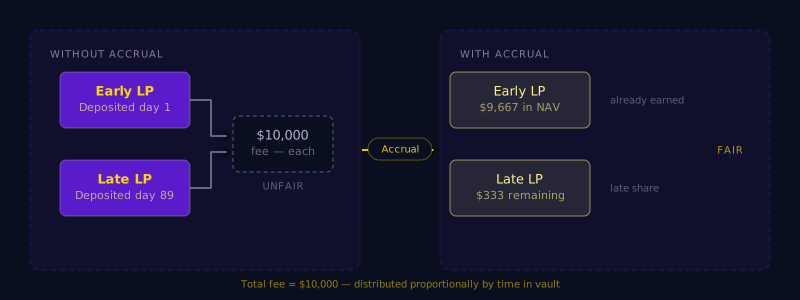
Yield is recognized incrementally over the life of each advance, not as a lump sum when cash arrives. This prevents late-entering LPs from capturing yield they did not earn.
Without accrual: LP-1 deposits at Day 1. LP-2 deposits at Day 89. On Day 90, borrower repays with $10,000 in fees. Both LPs benefit equally, even though LP-2 contributed capital for 1 day.
With accrual: Yield accrues daily. By Day 89, $9,667 of the fee is already reflected in NAV. LP-2 buys shares at the higher price and only benefits from the final $333.
This design ensures every LP is compensated for exactly the time their capital was deployed.
Accrual Granularity
NAV accrual is designed to be effectively continuous. Fees are calculated based on the aggregate fee rate across all active advances multiplied by elapsed time since the last update. The accrual period can be broken down to any time frame (daily, hourly, or finer) depending on implementation. Finer granularity provides more precise NAV calculations for LPs entering or exiting mid-period.
Continuous Capital Deployment
All vault capital not in active borrower advances is deployed to established DeFi lending protocols (Aave, Compound) for continuous yield. These positions are highly liquid and can be withdrawn instantly for redemptions or new advances. LPs benefit from both sources: borrower fees on active advances and DeFi lending yield on all remaining capital.
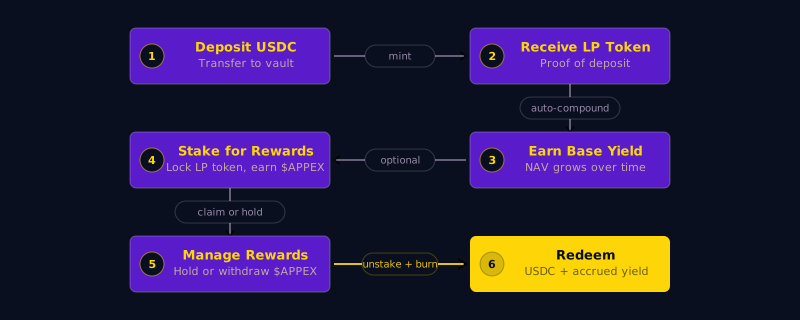
The LP Journey
Stage 1: Deposit
Deposit USDC into the vault. Receive LP tokens representing proportional NAV ownership. Base yield begins accruing immediately as borrowers draw and repay.
Stage 2: Earn Base Yield
As borrowers draw and repay, fees accrue to vault NAV. LP token value appreciates. No action required. Yield is entirely passive. An LP who deposits and does nothing else still earns returns from every borrower repayment.
Stage 3: Staking Decision (Optional)
Lock LP tokens and $APPEX into the staking contract to earn protocol fee distributions. Choose a lock period:
- No lock - 1.0x reward weight
- 3-month lock - 2.0x reward weight
- 6-month lock - 3.0x reward weight
The amount of $APPEX eligible for rewards is capped by LP tokens locked multiplied by the vault multiplier. See Staking for complete details.
Stage 4: Reward Management
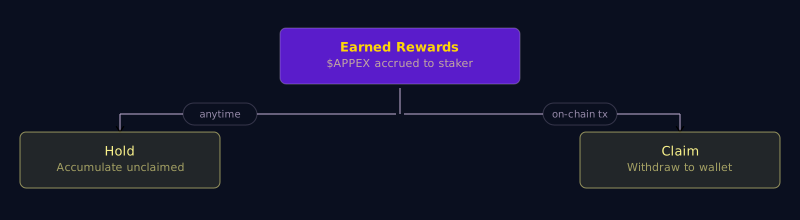
LPs earning staking rewards can:
- Hold - Accumulate unclaimed $APPEX rewards
- Claim - Withdraw $APPEX rewards to wallet
Stage 5: Portfolio Assessment
As NAV grows and $APPEX price moves, LPs reach natural decision points. If the LP's staking cap is fully used in one vault, they can provide liquidity to a new vault, lock fresh LP tokens, and stake additional $APPEX. The protocol does not dictate this choice. Market dynamics and personal risk assessment drive the decision.
Stage 6: Redemption
Submit a withdrawal request to redeem LP tokens for USDC. Redemptions are processed through the gated system described in Redemptions. During normal conditions, withdrawals process same-day. During high utilization, they may queue.
Note that redeeming LP tokens reduces the staking cap proportionally. An LP who redeems half their LP tokens can only stake half as many $APPEX at the optimal rate. This creates a natural friction against withdrawal for LPs who are earning staking rewards.
Tip: LPs who only want passive yield exposure can deposit and hold LP tokens without staking. Base yield accrues automatically through NAV appreciation. Staking is optional and designed for LPs who want to maximize returns by committing $APPEX alongside their liquidity.