

Governance
This page describes the appeX governance framework: who can vote, what they can vote on, how governance aligns with protocol growth, and the path from centralized operations to community governance.
Governance Power
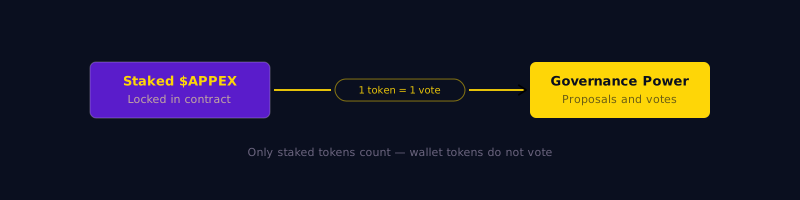
Governance power comes from staked $APPEX. Each staked token carries one vote. Only $APPEX locked in the staking contract counts. Tokens held in wallets or on exchanges do not confer governance rights.
This design is deliberate. It ensures that governance participants are aligned with the protocol on two levels: they are LPs who have committed capital (USDC deposited into the vault) and they have committed $APPEX to the staking contract. Participants who govern the protocol have real economic exposure to the consequences of their decisions.
The more $APPEX staked, the more decentralized and community-governed the protocol becomes over time.
Governance Scope
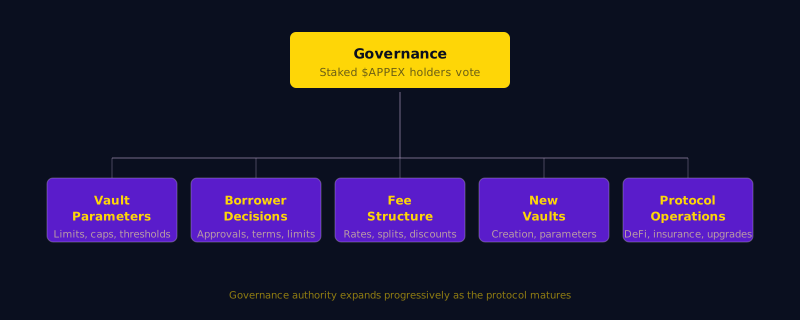
Staked $APPEX holders can vote on decisions that directly affect vault operations, borrower relationships, fee economics, and protocol growth.
Vault Parameters
These decisions control the day-to-day behavior of each vault:
- Advance limits (maximum percentage of vault capital in active advances)
- Daily redemption caps and per-request limits
- Minimum deposit requirements
- Deposit cap thresholds for capital efficiency management
Getting these parameters right matters because they balance two competing needs: maximizing yield through borrower advances and ensuring LPs can withdraw when they need to. Setting advance limits too high risks withdrawal delays. Setting them too low reduces borrower fee generation.
Borrower Decisions
These decisions control who can access vault capital and under what conditions:
- New borrower approvals and borrowing limits
- Borrower term modifications
- Borrower removal for non-compliance or credit deterioration
- Borrower evaluation criteria and minimum standards
Borrower quality is the single biggest determinant of vault risk. Governance over borrower approvals gives $APPEX stakers direct influence over the risk profile of the capital they have committed.
Fee Structure
These decisions control the economics of the protocol:
- LP yield fee curve parameters (minimum/maximum rates, term boundaries)
- Protocol fee guidelines and negotiation frameworks
- Fee discount rates for $APPEX payments
- Protocol fee split ratios (Treasury vs. staker distribution)
Fee governance determines LP returns, borrower costs, and the rate at which $APPEX is purchased through protocol fee distributions. Each parameter change has downstream effects across the entire protocol.
New Vault Creation
These decisions control how the protocol expands:
- Establishing new vaults for different industries or risk profiles
- Setting vault-specific staking multipliers
- Defining vault-specific fee curves and borrower criteria
- Approving vault parameters before launch
New vaults are significant decisions. Each vault creates new staking capacity, opens new markets, and introduces new risk categories. Governance ensures these expansions reflect the collective judgment of committed participants.
Protocol Operations
These decisions control infrastructure and operational parameters:
- DeFi protocol selection for capital deployment (which lending protocols are approved)
- Insurance provider selection and coverage parameters
- Staking contract parameter adjustments (epoch length, lock duration options, multipliers)
- Protocol upgrade approvals
DeFi capital deployment decisions are particularly important. The protocols selected for deploying unborrowed USDC (currently Aave and Compound) carry their own smart contract and liquidity risks. Governance oversight ensures only established, audited protocols with multi-year track records are approved.
How Governance Works
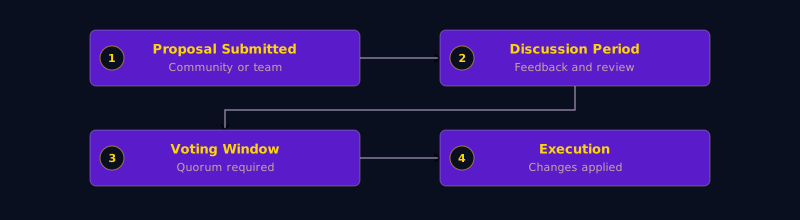
Info: The detailed governance process, including proposal submission, discussion periods, voting windows, quorum requirements, and execution mechanics, will be documented in full as the governance framework is finalized. The scope above represents the intended governance authority for $APPEX stakers.
Progressive Decentralization
appeX intends to follow a progressive decentralization model. In the early phase, the core team makes operational decisions for speed and efficiency. Over time, governance authority is planned to transfer to $APPEX stakers.
This approach is common in DeFi protocols because early-stage operations require fast decision-making: rapid borrower onboarding, parameter adjustments based on real usage data, and response to unforeseen edge cases. Fully decentralized governance from day one would slow these critical early decisions.
The following phasing is directional and subject to change as the protocol matures:
- Launch phase. Core team manages vault operations, borrower onboarding, and parameter settings. Governance framework is developed based on real protocol usage data.
- Growth phase. Governance is activated for key decisions. $APPEX stakers begin voting on borrower approvals, fee parameters, and new vault creation. The team retains operational authority for day-to-day management.
- Maturity phase. Governance authority expands to cover all protocol decisions. Multi-sig administration is replaced by fully onchain governance. The team transitions to a contributor role.
Info: This phasing represents the planned approach to decentralization. Specific timelines and phase transitions will be determined by protocol maturity, community readiness, and governance infrastructure development.
Why Governance Matters for appeX
appeX is infrastructure. As it scales across vaults, borrowers, and industries, the decisions about risk tolerance, fee structures, and capital allocation become increasingly consequential.
Placing these decisions in the hands of participants who have committed both capital and tokens ensures that governance is exercised by those with the most at stake. LPs who govern the protocol bear the economic consequences of their votes. If they approve a risky borrower who defaults, their vault NAV drops. If they set fees too high, borrower demand decreases. If they set fees too low, LP returns suffer.
This alignment between governance power and economic exposure is what makes $APPEX governance meaningful rather than performative.