

The Vault
The vault is the core economic engine of appeX. This page explains how it holds capital, deploys it across borrower advances and DeFi lending, handles borrower relationships, and scales across markets.
Vault Design
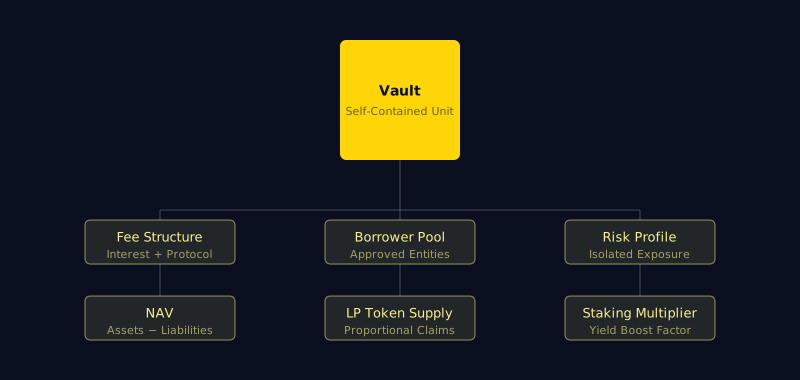
Each appeX vault is an isolated smart contract with its own:
- Fee structure and rate parameters
- Approved borrower pool with individually negotiated terms
- Risk profile and concentration guidelines
- NAV, LP token supply, and staking multiplier
Capital does not flow between vaults. Risk is contained at the vault level. If one vault experiences losses, other vaults are unaffected. This isolation is a deliberate design choice: it lets LPs evaluate risk on a per-vault basis and deposit capital only where they are comfortable.
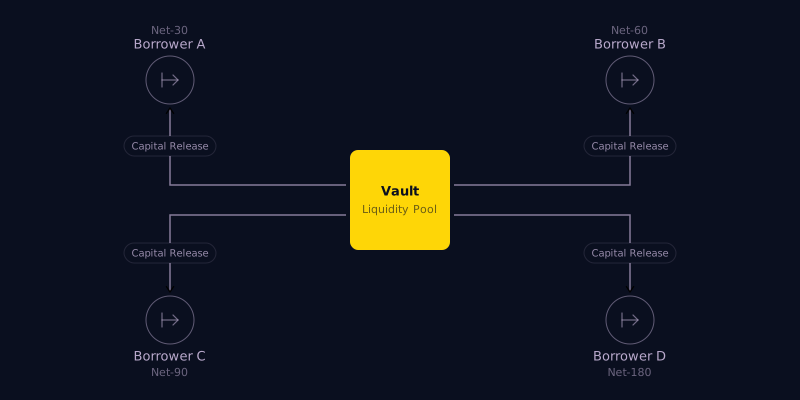
The initial vault serves multiple approved borrowers under a unified lending structure. Each borrower has individually negotiated terms based on their payment term duration, creditworthiness, and margin structure. Future vaults will be established through governance to isolate different industries, geographies, or risk categories.
Vault Parameters
| Parameter | Value |
|---|---|
| LP Input | USDC |
| Yield Source | Fees paid by borrowers on each advance |
| Loan Terms | Unique per borrower (e.g., Net-30 to Net-180) |
| LP Yield Fee | Negotiated per borrower based on term duration, volume, and creditworthiness (e.g., 5-15%) |
| Protocol Fee | Negotiated per borrower; splits 50/50 between Treasury and $APPEX stakers |
| DeFi Yield | All unborrowed capital deployed to Aave and Compound for continuous yield |
| Curator | appeX (manages vault operations, borrower relationships, risk) |
| Minimum Deposit | 1 USDC |
| Maximum Deposit | No hard cap |
Capital Deployment
Vault capital exists in two states: lent to borrowers or deployed in DeFi. There is no idle capital.
| State | Description |
|---|---|
| Active Advances | Capital lent to borrowers, earning LP yield fees. Locked until the borrower repays on their contractual terms. |
| DeFi Deployed | All remaining capital deployed to Aave and Compound for continuous yield. Fully liquid and withdrawable at any time. |
All USDC not currently in active advances is deployed to established DeFi lending protocols (Aave, Compound). These positions are highly liquid and can be withdrawn instantly to fund new borrower advances or LP redemptions.
When active advances reach a level where the remaining DeFi-deployed capital would not comfortably support redemption demand, new borrower draws pause until repayments land or fresh deposits arrive. This protects LP withdrawal capacity.
If borrower demand remains low relative to vault deposits, deposit caps can be introduced to maintain capital efficiency. This prevents dilution of effective yields.
Info: The vault does not liquidate outstanding receivables to facilitate LP redemptions. Receivables mature on their contractual timeline. Redemptions are funded by withdrawing from DeFi positions.
How Share Price Works
A critical property of the vault's design: deposits and withdrawals do not affect share price.
When an LP deposits USDC, they receive LP tokens at the current share price. When they withdraw, they redeem tokens at the current share price. The vault's total NAV changes, but the per-share value remains constant through these operations.
Only two things change share price:
- Accrued fees from borrower repayments increase share price. This is how LPs earn yield.
- Bad debt adjustments decrease share price. This is how losses are recognized.
This ensures LPs are rewarded for the yield their capital generates, not penalized or advantaged by the timing of other LPs entering or exiting.
Multi-Borrower Model
The vault operates as a one-to-many lending facility. Multiple approved companies can borrow from the same vault simultaneously, each under their own terms. This diversifies the vault's revenue sources and reduces dependence on any single borrower.
How Borrower Access Works
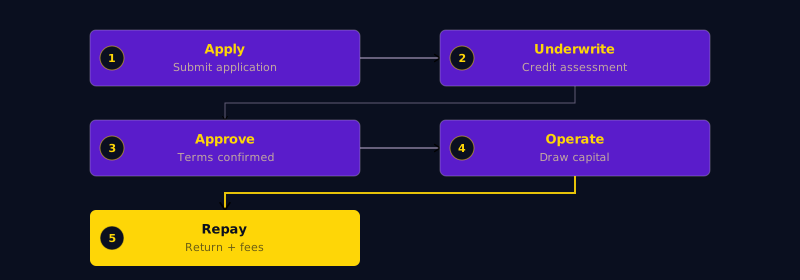
- Application. Company applies for vault access through appeX onboarding.
- Underwriting. appeX conducts credit evaluation, financial review, and compliance verification.
- Approval. Approved borrowers receive a borrowing limit and individually negotiated fee terms.
- Operation. Borrower draws capital as needed within their limit. Each draw carries an LP yield fee based on the payment term duration.
- Repayment. Borrower repays principal + fees when their underlying receivable collects.
Borrower Responsibility
The vault's counterparty is the borrowing company, not the borrower's customers, not the end recipients of capital. The borrower decides how to deploy funds on their side and is solely responsible for repayment.
This clean separation means:
- The vault does not need to track individual receivables
- LP risk assessment focuses on borrower creditworthiness, not downstream counterparties
- Borrowers can serve diverse use cases (instant payouts, supplier payments, growth capital) without requiring vault-level structural changes
If a borrower's customer fails to pay, that is the borrower's problem to solve. The borrower still owes the vault. This is a critical risk transfer that makes the vault's economics predictable for LPs.
Concentration Guidelines
appeX recommends borrowers implement internal concentration limits to manage portfolio risk:
| Limit Type | Recommended Cap |
|---|---|
| Per-customer exposure | 20-25% of borrower's outstanding advances |
| Per-supplier exposure | 10-15% of outstanding advances |
When limits are exceeded, new advances queue until existing positions mature. These are recommended guidelines. Borrowers manage their own downstream risk. The vault's exposure is to the borrower entity.
Scaling Through Borrower Growth
The vault benefits from both horizontal and vertical scaling:
Horizontal scaling. Each new borrower onboarded brings their own customer base, transaction volume, and fee generation. More borrowers mean diversified risk and increased fee generation. If one borrower plateaus or exits, others continue.
Vertical scaling. Each existing borrower growing their transaction volume increases vault activity. More volume means more advances, more fees, and more yield for LPs. Existing borrowers become more valuable over time as their businesses grow.
Future Vaults
Additional vaults are established through governance when the protocol expands into new markets or risk categories. New vaults are launched carefully, ensuring they primarily separate risk rather than fragment liquidity.
Why Separate Vaults
Different industries carry different risk profiles. Ad receivables behave differently than trade invoices, which behave differently than SaaS contracts. Separating these into distinct vaults allows:
- LPs to choose their risk exposure. Deposit into vaults matching your risk appetite and return expectations. A vault serving media companies has a different profile than one serving manufacturing supply chains.
- Borrowers to access terms optimized for their industry. Payment terms, fee curves, and concentration limits can be tailored to each market's characteristics.
- The protocol to scale horizontally. Each new vault adds capacity without affecting existing vaults. New markets may also attract different types of liquidity providers.
What Connects All Vaults
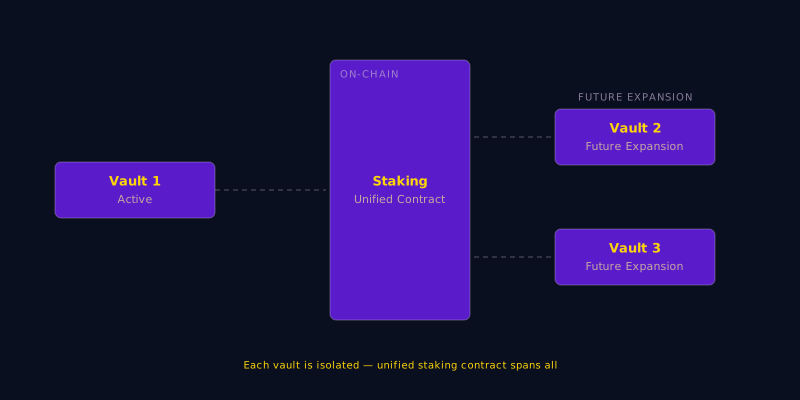
While each vault isolates capital and risk, the $APPEX staking contract sits centrally across all vaults. LPs from any vault can lock LP tokens and $APPEX into the unified staking contract and receive protocol fee distributions from the entire protocol.
This means $APPEX stakers benefit from the growth of every vault, not just the one they deposited into. Each new vault creates new staking capacity and absorbs $APPEX into productive, locked positions rather than exchange sell pressure.
Tip: For details on how staking works across multiple vaults, see Staking. For details on how vaults are governed, see Governance.